Open WebUI as a ChatGPT Alternative for Self-Hosters
Open WebUI lets self-hosters route AI work across multiple models without vendor lock-in.
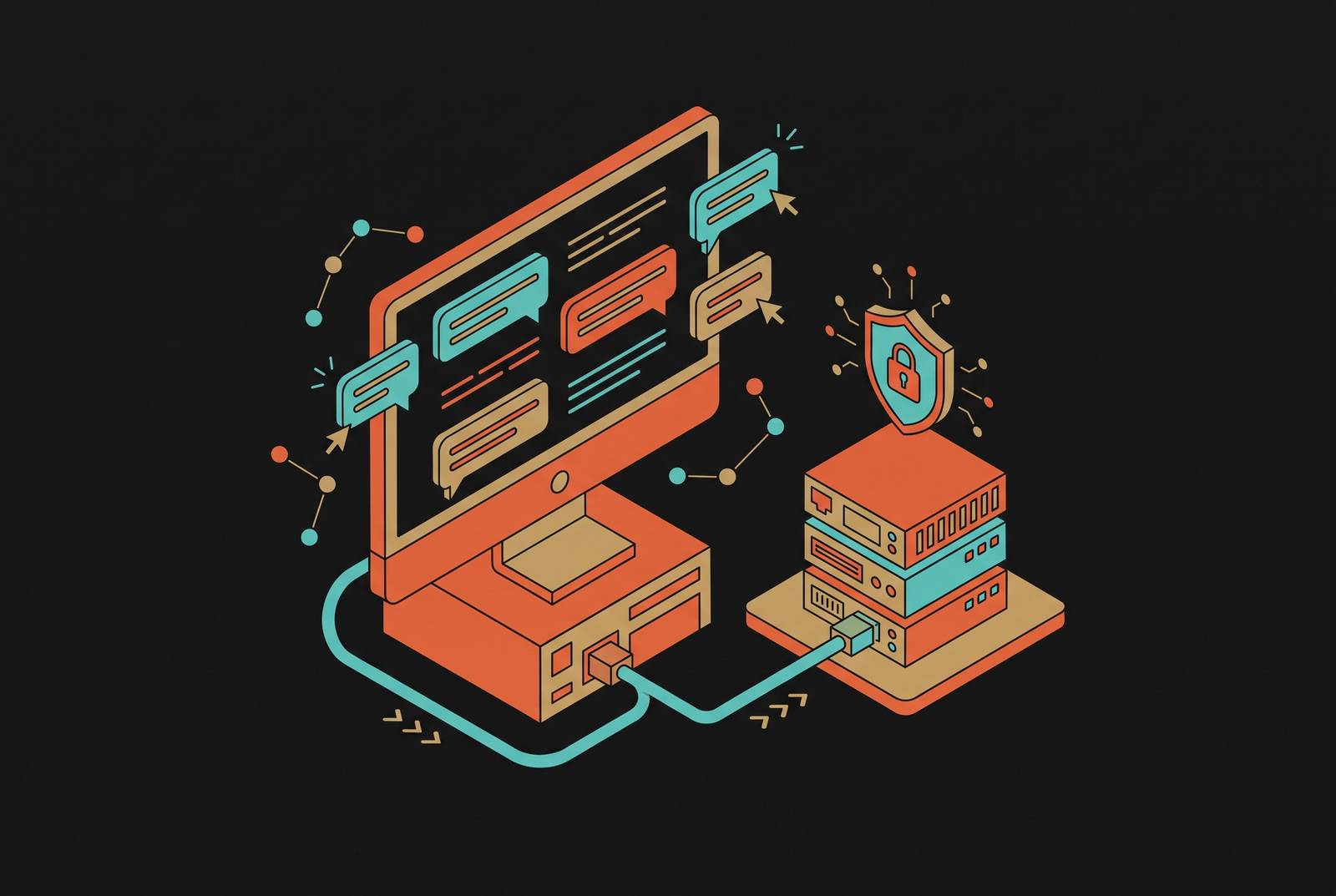
ChatGPT's architecture puts a ceiling on what any subscription tier can offer. Prompts process on OpenAI's servers. Model choice stays locked to whatever OpenAI decides to ship. Rate caps apply even on paid plans, and there's no on-premises option, not even at the Enterprise tier. Those four facts together explain most of why self-hosters start looking elsewhere.
The people hitting that ceiling aren't a niche. If you're a power user, you can hit Plus-tier rate limits right when you need a long, intensive session most. Teams feel it differently: the Team tier runs $30 per user per month, so a ten-person team is paying hundreds of dollars monthly for access that still can't be customized at the infrastructure level. And if you want to run something other than what OpenAI provides, a Llama variant for fast local queries, a different provider entirely for long-context analysis, you simply can't do that inside ChatGPT. The product doesn't bend that way.
One clarification matters before going further. ChatGPT itself cannot be self-hosted. Keep that distinction in mind, because it shapes everything that follows: Open WebUI is a different kind of tool solving an adjacent problem to ChatGPT.
What Open WebUI actually is, and what it is not
Open WebUI is a web interface. It has no model of its own and no built-in intelligence. What it does is connect to whatever model backend gets pointed at it, which is a meaningfully different thing from being a ChatGPT clone.
That connection can work two ways. In cloud API proxy mode, Open WebUI acts as a front end for OpenAI, Anthropic, Google, Groq, or any OpenAI-compatible endpoint. In this mode you need as little as 2GB of RAM, while costs scale with tokens used rather than seats purchased. In hybrid mode, queries route to local or cloud models depending on how sensitive or complex the task is. A document full of patient records might stay local. A request to summarize a public news article might go out to a cloud model. The system decides by rules the administrator sets, not by what a single vendor's product tier allows.
Getting it running takes one of three paths: pip, Docker, or Kubernetes. The Docker install is a single command line. Once it's running, any browser on the network can open it, no client software, no per-device license.
An interface layer that routes work to the right backend depending on the sensitivity of the task appears elsewhere in the AI tooling world too. Vellum works on a similar principle: it connects across a person's tools and services, learns preferences over time, and takes on routing and execution tasks automatically, while the person stays in charge of the decisions that matter. The mechanism is different (Vellum isn't self-hosted infrastructure), but the underlying idea, let the assistant layer handle the routing so the tools underneath stay swappable, is the same one Open WebUI applies at the interface level.
The concrete capabilities ChatGPT's architecture cannot match
A handful of things Open WebUI does aren't missing from ChatGPT because OpenAI hasn't gotten around to building them. The closed-cloud model itself rules them out, structurally, not any product roadmap.
Start with model flexibility. Open WebUI can connect to multiple backends at once and route different tasks to different models within a single conversation interface: one provider for creative writing, another for long-context document analysis, a local model for fast, private queries that never need to leave the building. ChatGPT, by definition, only ever offers you OpenAI's models.
Then there's retrieval. Open WebUI includes built-in RAG (retrieval-augmented generation) without needing a separate service bolted on. Documents uploaded this way never leave the organization's own infrastructure, a guarantee ChatGPT cannot simply add. OpenAI would have to abandon the entire model of processing everything in its own cloud.
Web search and image generation follow the same pattern. Open WebUI integrates with multiple search providers and connects to DALL-E, ComfyUI, or AUTOMATIC1111 (Stable Diffusion WebUI) for image work, giving users a choice of engine. Voice tells a similar story from the other direction: ChatGPT's macOS app retired its voice mode on January 15, 2026, shifting voice interactions to web, iOS, Android, and Windows instead. Open WebUI, meanwhile, keeps hands-free voice and video chat available across every setup it runs on, because the feature lives in the interface layer, not at the mercy of one company's platform decisions.
For teams, the administrative layer is where the structural gap shows most clearly. Role-based access control (admin, user, pending), single sign-on, LDAP, and multi-factor authentication all come included, with no enterprise tier fee required to unlock them. You also get workspaces, a user management interface, and group-level permissions out of the box. Pipeline extensibility, the ability to inject custom processing steps directly into a conversation's flow, has no ChatGPT equivalent. These aren't missing checkboxes. You get them because you run software you control instead of renting access to software someone else controls.
Open WebUI's multi-model routing and native RAG point toward something bigger than convenience: instead of accepting whatever one vendor bundles together, organizations can now compose their own stack, choosing the search engine, the embedding model, and the language model independently. An AI assistant that keeps a persistent memory of a person's preferences takes that idea a step further. Rather than just connecting to multiple models, an assistant that remembers your preferences can learn which model you reach for on which kind of task and route the work there without you having to ask each time.
Enterprise Deployment in Practice
Enterprise adoption of Open WebUI isn't theoretical. Astellas Pharma put the platform in front of more than 3,000 employees on a secure Azure deployment, and staff used it to create and share over 420 custom AI models, with a large majority of participants reporting significant efficiency gains. So a pharmaceutical company, under real regulatory scrutiny, runs a self-hosted interface at scale on its own terms.
The deployment pattern that makes this work tends to follow a consistent shape. The organization runs Open WebUI on infrastructure it controls, whether that's on-premises servers or a private cloud tenancy through Azure, AWS, or GCP. Cloud APIs get used only for non-sensitive workloads. Anything sensitive routes to a model running locally, inside the same perimeter as the data itself.
That architecture is what lets a self-hosted deployment, configured with proper controls, position itself as SOC2, HIPAA, GDPR, and FedRAMP ready. ChatGPT Enterprise lacks on-premises deployment, so it can't make the same claim. If a compliance team can't control a server, it can't audit it, and no subscription tier changes that.
Development pace matters to any organization deciding whether to commit. The v0.11.4 release shipped in September 2026, and it reflects a development cadence that sped up through the year. So if you adopt the platform, you build on a codebase under active work, not one that's gone quiet.
The License Change
Most self-hosters won't notice Open WebUI's recent license change. Individuals running it for themselves, teams deploying it internally, enterprises running it as delivered: for all of these, the software stays free to run and self-host, full stop on the practical consequences.
The change matters to a narrower group. It lands hardest if you build your own product on top of Open WebUI, or if your legal department needs a specific approved license before you deploy anything. For that group, the current license creates a real obstacle, not a theoretical one.
That's the gap LibreChat fills. It remains under a permissive license, which makes it the right pick for any organization that needs to modify and redistribute the interface itself, rather than simply run it as-is behind a login screen.
Where Open WebUI's competitors genuinely win
The self-hosted chat interface space has grown crowded enough that picking the right tool depends on the job at hand, not on which project has the largest community.
LibreChat gives you the interface experience closest to ChatGPT, and its permissive license makes it the natural choice if your team needs to white-label or fork the product. It supports agents built with MCP tools, code artifacts in React, HTML, and Mermaid, a sandboxed code interpreter, message forking, and conversation branching. Version 0.8.8 (stable) shipped September 30, 2026, following a string of release candidates through that same month, a sign of active, ongoing development. Reach for LibreChat when the license is non-negotiable or when a team wants the UX to feel as close to ChatGPT as possible.
AnythingLLM takes a narrower focus: document and knowledge-base work. It organizes material into workspaces, ships with a no-code agent builder, and installs as either Docker or a desktop app. Reach for AnythingLLM when the main job is chatting with PDFs, internal wikis, and knowledge bases.
Jan serves a different need entirely: everything running locally, with no server to manage. It's Apache-2.0 licensed, runs local models through llama.cpp, and its v0.8.4 release shipped July 23, 2026, with versions available for macOS, Windows, and Linux. It supports MCP for agent-style tool use, and you can also connect it to cloud models using your own API key when that helps. Reach for Jan when nothing should leave your laptop and you don't want to think about server management.
Dify sits apart from the others because it's built for teams shipping an AI product, not teams having conversations with one. It's a workflow and agent platform for building chains, logic flows, and RAG pipelines. Reach for Dify when you want to build AI features into something else, not chat directly.
Community size is also a practical signal, apart from feature lists. Open WebUI's closest self-hosted competitors are in a noticeably smaller range of community-popularity metrics, a gap visible in concrete ways: more tutorials circulating online, faster turnaround on bug fixes, and a bigger ecosystem of community-built plugins. For a team without a dedicated infrastructure engineer on staff, that difference can matter as much as any single feature.
Where Vellum Fits for the Intelligence Layer
Open WebUI's trade is a straightforward one to name: control and data sovereignty in exchange for operational overhead. Someone on the team needs to understand Docker, size the hardware correctly, manage SSL certificates, handle backups, keep up with updates, and vet plugins before a non-technical teammate installs something risky. That's a real cost, and for some organizations it's the right cost to pay. For others, it isn't.
Consider the team whose actual constraint isn't data residency or compliance but decision fatigue: too many tools, too much context-switching, too little time spent on judgment calls that actually require a human. Vellum is built for that constraint specifically. It offers a personal intelligence layer that holds onto context, learns patterns over time, and works across models, OpenAI, Anthropic, Gemini, and open-weight models running through Ollama, without asking the team to stand up or maintain any infrastructure of its own.
A few distinctions separate it from both ChatGPT and Open WebUI. Memory is built to persist across conversations, not scoped to a single session the way a standard context window works. Tasks get carried out autonomously across tools like email, calendar, and files, so they don't stay confined to a chat window. Memory and credentials live locally or in the cloud, with no data accessible to Vellum unless the user opts in, a privacy posture that speaks to the same compliance concerns self-hosters raise, without requiring anyone to run a server. And model flexibility comes without model management: switching providers as needs change doesn't require touching a configuration file.
The fit is clearest for individuals and teams who want to keep their judgment in the loop but can't spare the engineering hours it takes to run and maintain an AI platform themselves. Vellum adds capability to the person already doing the work, so you don't have to add one more system to keep running.