Updating and Maintaining Self-Hosted AI Tool Stacks
Keeping self-hosted AI stacks running requires more engineering discipline than launching them.
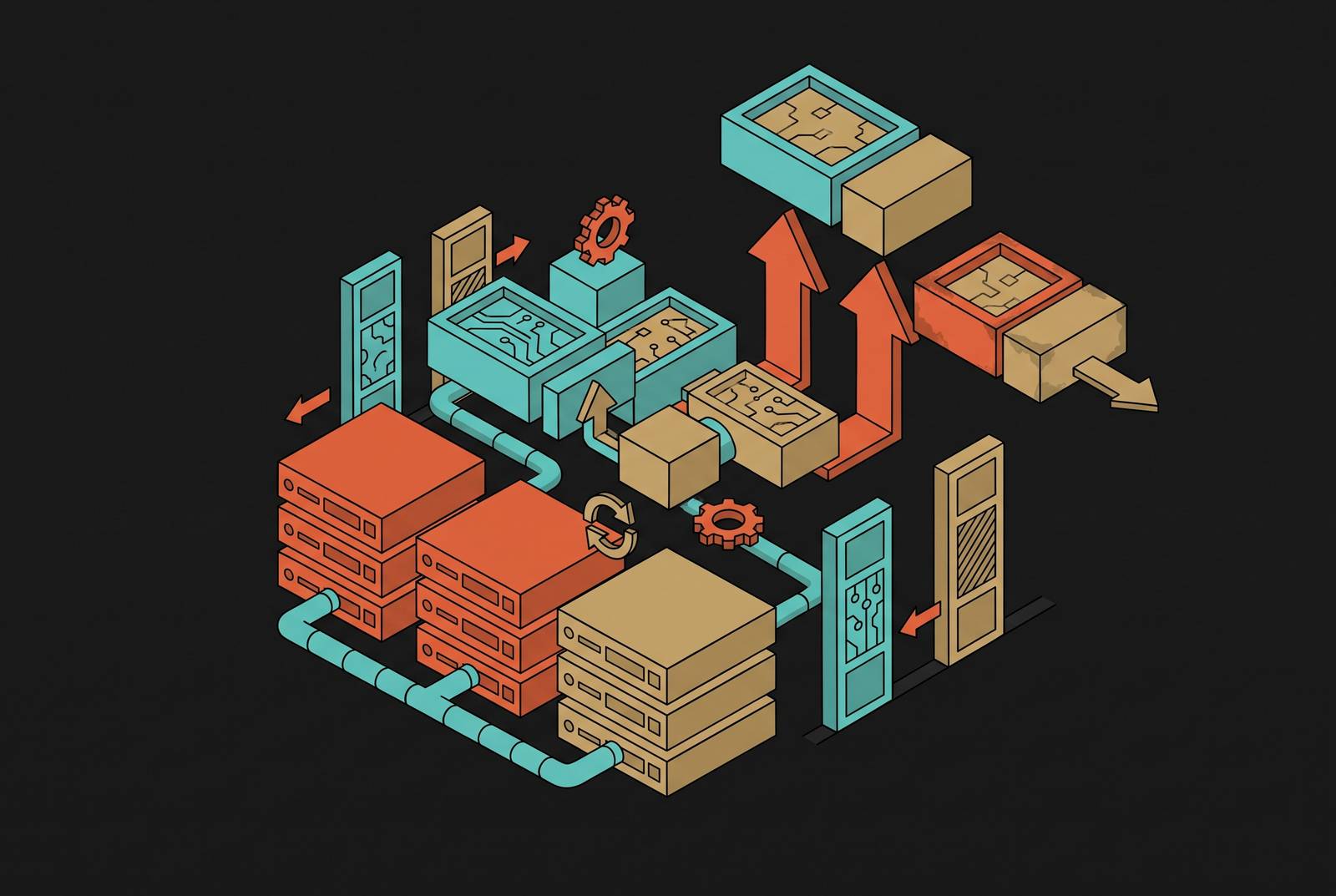
Getting a self-hosted AI stack running is not the hard part. Keeping it running, month after month, as models change and dependencies shift underneath it, is where teams consistently underestimate the work. Pulling a model with Ollama, wrapping it in a FastAPI endpoint, wiring in a vector store: a team with basic DevOps skills can do all of that over a weekend. The real test starts the moment that stack takes its first production request.
From that point forward, nothing stays still. Model versions change. Python dependencies conflict with each other in ways that only become visible in production weeks after the change that caused them. Security patches drop on a schedule nobody controls. The eval suite that gave a clean pass last month may already be testing the model against a codebase that no longer exists in production. A standard web server stays static until someone pushes new code. An AI stack has no such calm: model weights, the inference runtime, the vector store client, and the orchestration tooling around all of it each move on their own schedule, independent of the others. That is the actual engineering challenge, and it's the one this piece is built around: not how to launch a stack, but how to keep one alive.
The three failure modes that accumulate into operational debt
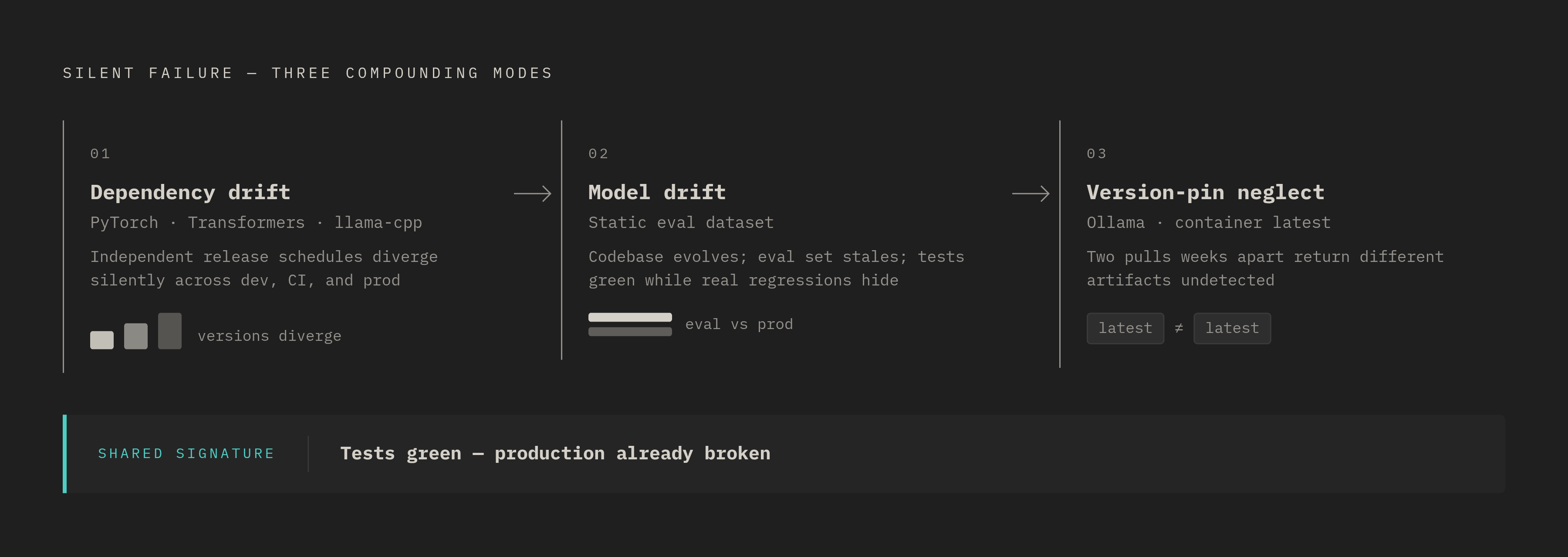
Self-hosted AI stacks rarely fail on day one. They degrade through three separate mechanisms that teams tend to treat as isolated incidents, but it's actually one structural pattern repeating itself.
The first is dependency drift. Python AI stacks are notoriously hard to reproduce across environments, and a typical stack is not a single library but a stack of them: PyTorch, Transformers, llama-cpp-python, a vector store client, each carrying its own native dependencies and version constraints. llama-cpp-python alone needs a C++ compiler at install time and produces different binaries depending on whether the target is CPU or GPU. Keeping that consistent across development, CI, and production takes deliberate tooling. Good intentions don't do it.
The second is model drift, which follows a specific, recognizable pattern: an enterprise deploys a model and builds an evaluation dataset against its internal codebase. The codebase keeps evolving. The eval dataset does not. Six months pass, and an MLOps team upgrades the open-source model. Automated tests pass, because they still check against the outdated eval suite. The new model then breaks against the actual, current production codebase. What failed there wasn't the model. The feedback loop meant to catch the problem had already gone stale, so a real regression looked, on paper, like a safe upgrade.
The third is version-pinning neglect. Run ollama pull llama3.1 today, and run it again in three months: there's no guarantee the second pull returns the same model version as the first. Without explicit version pinning, the idea of a reproducible production environment is mostly an illusion.
The labor cost of sustaining a stack
Infrastructure is not what makes self-hosted AI expensive to run. The specialized engineering labor needed to keep the stack healthy is, and that cost gets left out of most build-versus-buy comparisons before a single server is provisioned.
Sustaining a stack calls for a specific set of roles, and each one exists because a specific failure mode demands it. An infrastructure engineer who understands both GPU memory management and container orchestration commands a premium, because the talent pool for that combination is small and the downside of getting it wrong (a runaway query that crashes the production stack) is severe. An MLOps specialist handles versioning and deployment cycles, watches for model drift degrading output quality, and decides when a RAG approach solves a problem versus when the model actually needs fine-tuning, so the system can stay relevant without triggering a full retraining cycle every time requirements shift. In regulated environments, a data privacy officer keeps a secure internal tool from becoming a compliance liability.
Small teams face a particular trap here. One engineer maintaining an AI application on raw infrastructure ends up spending most of their time on operations. Lean staffing produces what amounts to a hero culture: the moment that one engineer leaves, the team can no longer patch its own inference servers. But is that really a staffing problem, or a structural one? Regulated enterprises face a different version of the same calculus. For financial services, healthcare, or defense, where data can't leave the perimeter, self-hosting is the requirement, and a realistic production deployment still adds substantial engineering overhead for model maintenance, security patching, performance monitoring, and incident response, regulation or no regulation.
The pattern that tends to emerge from this calculus is hybrid: run local models for high-volume or sensitive work, and reach for a managed or cloud model only on the hardest slice of the problem. That concentrates engineering effort where it actually pays off, rather than spreading it evenly across a stack that doesn't need uniform self-hosting everywhere. It also sets the terms for everything that follows: dependency discipline, model versioning, testing, and rollback are the practices that make that concentrated effort sustainable.
Dependency management: pinning, locking, and environment parity across dev, CI, and production
Dependency drift is preventable. It takes explicit, enforced conventions for pinning versions and checking environment parity at every stage of the pipeline, not a general sense that things should be kept up to date.
Pin everything that can drift. Model versions in Ollama and Hugging Face should use digest-level or explicit version tags, not floating tags like latest or shorthand that quietly resolves to different weights over time. Python package versions need the full dependency tree locked, including transitive dependencies, using a lockfile that travels with the codebase and gets regenerated on a defined schedule. Base container images should pin to a specific digest instead of a rolling tag, because a base image update can change native library behavior even when the application code hasn't moved.
The C/C++ build layer deserves its own attention. llama-cpp-python and similar packages produce different binaries for CPU and GPU targets, so the safer pattern is to maintain separate, explicitly tagged images for each hardware target rather than trusting runtime detection to sort it out.
Environment parity has to be validated in CI, and not just at the level of Python package versions. The CI environment needs to match production in architecture, CUDA version, and native library versions. If you skip that, CI passes that production fails become close to guaranteed.
Supply chain risk belongs in this same conversation as a practical threat. In March 2026, two malicious PyPI releases were published after a compromise in the release process of a popular AI routing package, the Mercor/LiteLLM incident. Verifying package provenance and monitoring for supply chain alerts is part of ordinary dependency management, not a separate security function bolted on afterward.
Model versioning and registry management as a production engineering practice
Model weights are production artifacts. They need the same versioning discipline as application code, yet most teams manage them with far less rigor than they'd ever accept for their own software.
A model registry stops being optional once a stack reaches production scale. MLflow's Model Registry gives teams centralized storage for model versions, stage transitions, lineage tracking, and version-level annotations. Its alias system uses labels like @champion and @challenger, so teams can assign flexible labels without locking themselves into rigid stage hierarchies that break the moment a workflow changes shape. MLflow 3.0 extended this further, adding support for generative AI applications and agents by connecting model versions to code snapshots, prompt configurations, and evaluation results. That means the full context behind a deployment becomes reproducible, not just the raw weights sitting in storage.
The weights are only part of what needs packaging. KitOps packages models, datasets, code, configuration, and other project artifacts (prompts and agent skills included) into a versioned ModelKit, using a standard container packaging format that works with existing container registries and Kubernetes infrastructure. The practical pattern that follows: track with MLflow, then package and ship with KitOps.
Serialization format deserves a full beat of its own, because it's a security concern as much as a technical one. Pickle is the most common serialization format for PyTorch models, and Pickle executes code while the file loads. Opening a model file in that format is functionally the same as running an unknown program on the host machine. JFrog's 2026 scanning of Hugging Face found roughly 100 models showing malicious code execution patterns. Safetensors stores only tensor data with no executable code attached, and PyTorch 2.6 changed its default loading behavior to refuse arbitrary code execution. Any team still loading Pickle-format weights from unverified sources is carrying a vulnerability it probably hasn't audited.
Project health is its own versioning input, and it belongs in the same review cycle as everything above. A project with no visible releases or commits in six months counts as effectively unmaintained, so release cadence deserves a spot on the same monitoring schedule as dependency versions. LocalAI ships every week, so teams should pin versions carefully for stability. GPT4All has shipped no feature release since v3.10.0 on February 25, 2025, a signal any team that depends on it should weigh. Tool selection is a running input into the same versioning discipline applied to models and dependencies.
Building a testing pipeline that catches regressions across model updates
The most dangerous state a self-hosted AI maintenance workflow can be in is a test suite that still passes while no longer reflecting production conditions, and that happens to be exactly where most teams sit when they go to upgrade a model.
The eval dataset established earlier in this piece is the clearest case of the problem: a static eval dataset checked against a codebase that has since moved on. Tests pass against the old benchmark. The new model fails against the current one. That failure traces back to treating the eval dataset as a fixed asset, something built once at launch, rather than a living artifact that needs the same ongoing maintenance as the code it's meant to test.
A testing pipeline built to catch this works in layers. Unit-level output tests run deterministic checks against a fixed set of representative inputs, covering format compliance, refusal behavior, and factual anchors, and every proposed model version runs through them before promotion. Regression tests against production traces go further: periodically sample real production inputs and their expected outputs, fold them into the eval suite, and test new model versions against that living, growing dataset rather than only the original benchmark set from launch day. Integration tests across the full stack matter just as much, because model output rarely stays isolated. It feeds into vector store retrieval, response formatting, tool calls. A model upgrade that quietly changes output format can break a downstream parser without tripping a single model-level test, so the chain needs testing as a chain, not component by component.
None of this works without automated promotion gates. A candidate model version shouldn't reach production without clearing defined eval thresholds first, because manual promotion decisions made under time pressure are exactly where regressions slip through.
This is where the registry work from the previous section pays off directly. MLflow 3.0's linkage between model versions, code snapshots, prompt configurations, and evaluation results means a team can answer a specific question for any version currently running in production: what eval results justified promoting this version? If that question can't be answered on demand, the testing pipeline isn't actually doing its job.
Rollback strategy and staged rollout as non-negotiable operational primitives
Testing catches regressions before they reach production. Rollback and staged rollout contain the damage from whatever gets through anyway, and a team that can't roll back a model update within minutes of spotting a regression has no safe way to upgrade frequently. The likely response is to avoid upgrading at all, which only builds up the exact version debt this piece opened with.
Rollback depends on pre-staged artifacts. The previous production model version, meaning its weights, configuration, prompt templates, and inference runtime configuration, needs to be ready for immediate redeployment without a rebuild. That's a registry management requirement to plan for in advance, not something to improvise during an incident.
Staged rollout limits how much damage a bad update can do. Promoting a new model version to a canary slice of production traffic before a full rollout exposes behavioral differences under real load, conditions that synthetic tests rarely reproduce. That matters because differences in AI output quality often only become visible at the distribution level across many requests, not in any single test case checked in isolation.
Cloud APIs carry a version of this problem that self-hosted stacks don't face in the same way. An API provider can update model behavior without notice: an output that worked reliably last month can produce something different today, with no version control, no rollback path, and no warning that anything changed. That is a real argument for self-hosting in any workflow where output stability is a hard requirement, not a point against cloud APIs generally.
Rollback triggers need to be defined before an upgrade ships, not after something has already gone wrong. Teams should decide in advance what metric thresholds or behavioral signals count as a rollback event. Without that groundwork, the decision to roll back turns into a high-pressure judgment call made in the middle of an incident, and those calls tend to come too late to matter.