What Local by Default Means for AI Data Handling
Hardware improvements and cost economics are flipping how AI systems process data.
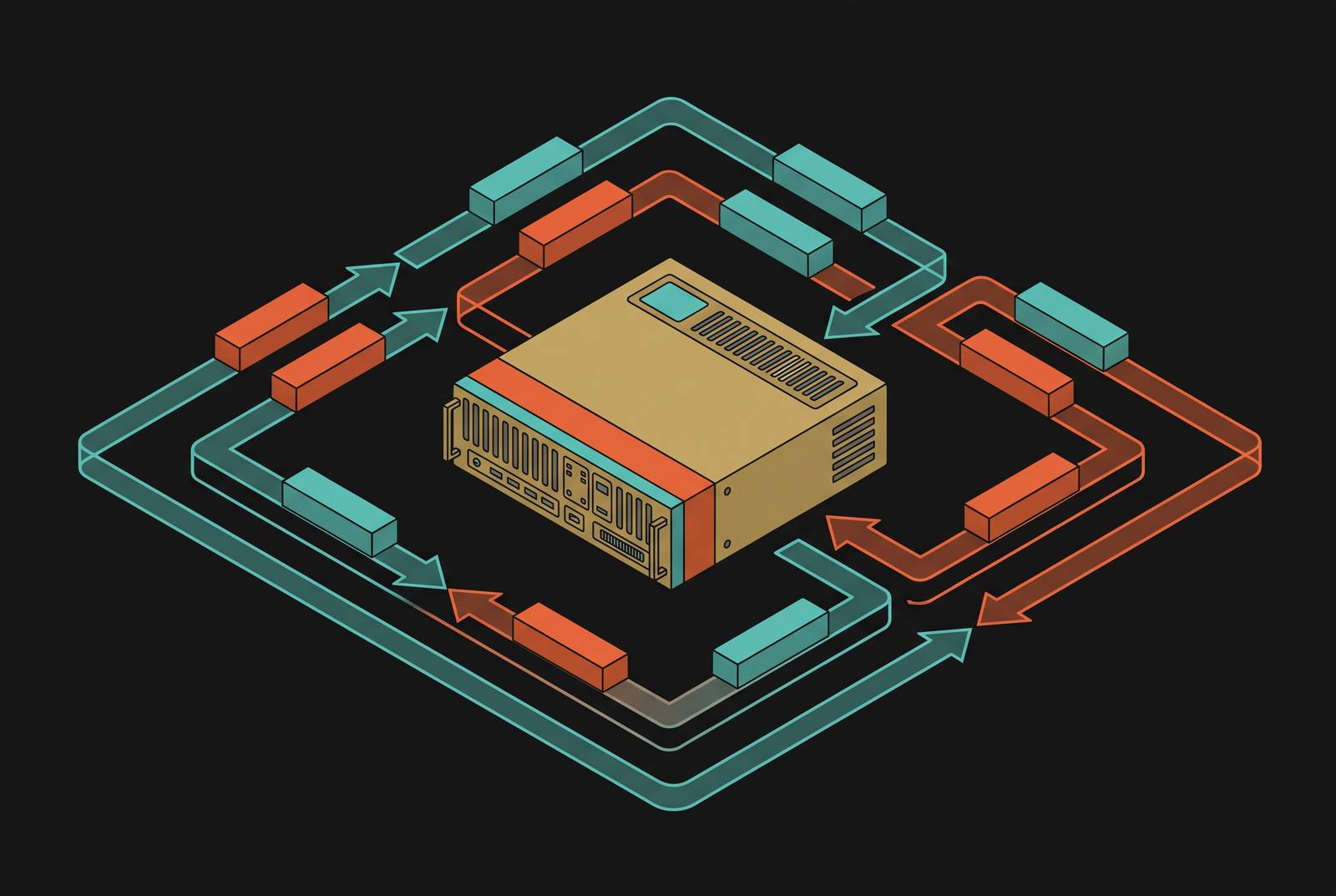
Between 2022 and 2024, the standard pattern for building AI into a product was simple: take the user's prompt, send it to a remote cloud API, wait for a response. That pattern is now being deliberately flipped. Local or on-premise infrastructure answers the request first, and the cloud only gets called in when local capacity genuinely runs out. This is a change in the basic architecture of how AI systems move data, and three forces are driving it at the same time.
The first is hardware. The flagship versions of those same model families still need multi-GPU, server-class machines to run, but the smaller variants have gotten good enough to handle real work on a phone or a laptop, making on-device inference a practical default.
The second force is cost. Local inference is now substantially cheaper per token than the equivalent cloud API call, once hardware gets amortized over a steady workload. That's a reversal of the math that made cloud the obvious choice in the first place. When every request had to be paid for individually through an API, cloud made sense. When an organization is running the same kind of request thousands of times a day, owning the hardware starts to win.
The third force is adoption. Enterprise AI inference that runs on-premise or on-device has grown substantially since 2023, and it has become the default privacy strategy for organizations working under GDPR and Law 25. None of these three forces, on its own, would have been enough to flip the default. Together, they make local-first infrastructure the practical starting point for AI deployment.
What "local by default" means as an architecture
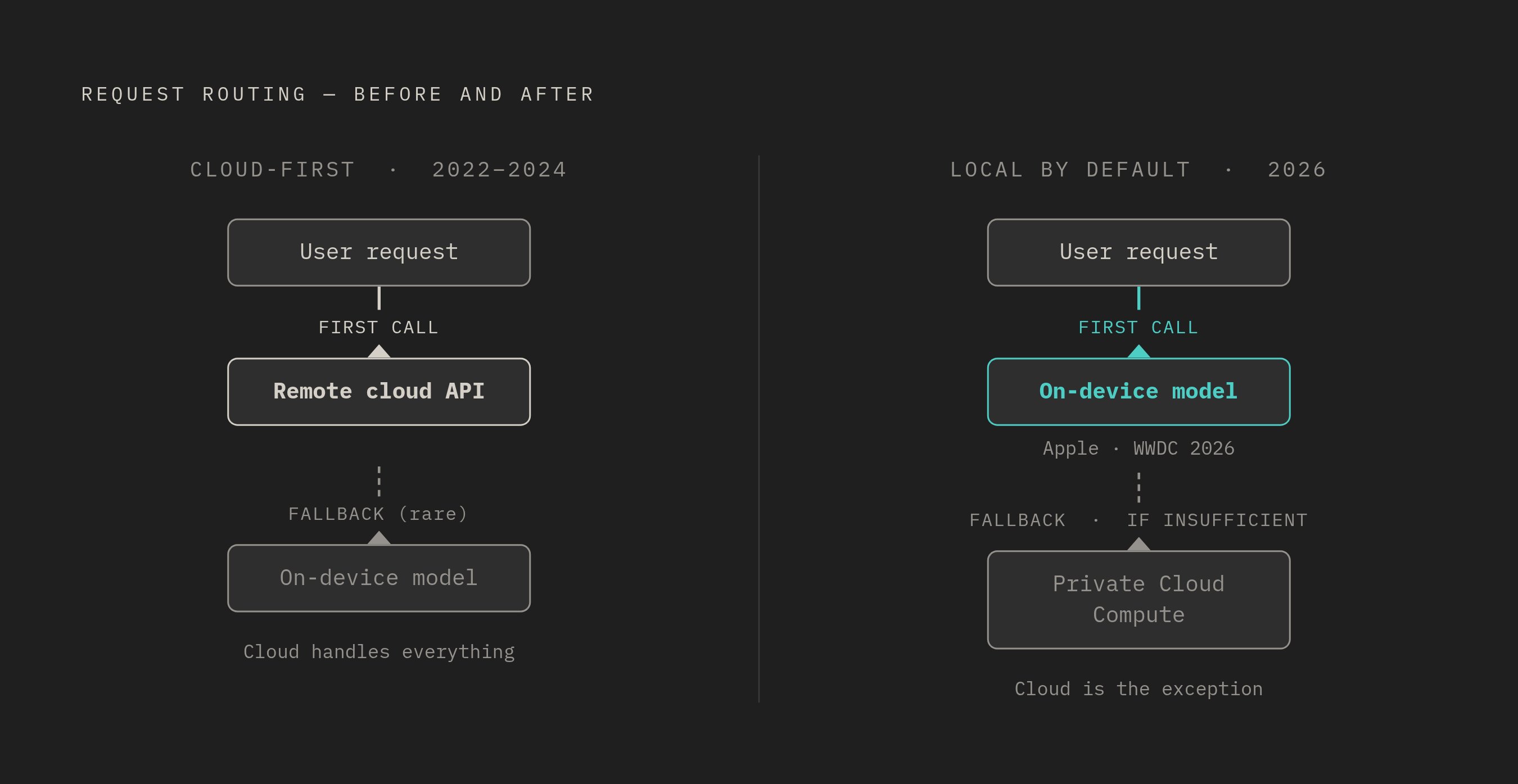
Local by default means something specific: the on-device or on-premise model is the first call, and the cloud is the fallback used only when local capacity isn't enough. Apple's approach, shown at WWDC 2026, is the cleanest example of this pattern in production. The on-device model handles the request first. If it can't, the request routes to Private Cloud Compute. The fallback exists, but it's the exception, not the rule.
The same pattern appears in other companies' products. Google's Gemini Nano runs on Android in a similar way: Pixel's Call Screen feature processes calls entirely on the device, so the actual audio of the call never leaves the phone, while Gemini Nano adds smarter contextual replies within Call Screen on Pixel 9 series devices. Three different companies, three different products, the same underlying architecture: local first, cloud only when needed.
What local by default is not matters just as much as what it is. Running locally doesn't mean a system is offline. A local-first system can still hand off complex queries to the cloud when it needs to, as the Apple and fallback examples show. Running locally doesn't mean a system is open source, either. A proprietary model can run entirely on a device, and an open-source application can still quietly send telemetry back to its developer. Organizations still have to work through their own HIPAA obligations, attorney-client privilege rules, or whatever regulatory framework applies to them. Local by default is an architectural starting point, not a checklist that's already been completed.
The core data-handling problem that local by default solves
Storage isn't the hardest part of handling data for AI systems. The hardest part is the moment data leaves an organization's own infrastructure and enters someone else's API pipeline, because at that moment control over the data shifts from architectural to contractual. Before that moment, an organization decides who can see its data and how it's used. After that moment, those decisions depend on a vendor's terms of service, their security practices, and how well they've implemented both.
A typical AI request in 2026 doesn't go from a device straight to a model and back. It passes through several layers: the device itself, an edge network, the model provider's API, a logging system that keeps records of the exchange, and often a third-party pipeline used to evaluate model quality. Each layer is a point where something could go wrong, and one compromised vendor anywhere in that chain can expose a huge number of conversations at once, since the exposure isn't limited to a single user's data but to everything that vendor touches.
AI systems leak data in ways that traditional software doesn't. The risk isn't concentrated in one place. No single fix, like better encryption or a stricter access policy, closes the gap on its own.
There's also a tension built into how useful AI systems get: they improve with more context. For organizations whose advantage comes from proprietary data, financial models, drug discovery datasets, legal case histories, customer behavior patterns, sending that data to a third-party API is a decision about how much risk the organization is willing to carry.
Shadow AI makes the problem worse. Simply not sending the data out addresses structurally what careful wording in a vendor contract can only partially manage.
How the inversion changes compliance
Local by default changes what compliance actually rests on. When data never leaves an organization's own infrastructure, entire categories of regulatory requirement get satisfied by the architecture, not managed through paperwork.
GDPR offers the clearest example. Sending customer data to an external API for inference counts as a data transfer under GDPR, and that triggers requirements: a legal basis for the transfer, potentially a full Data Protection Impact Assessment, and adequate transfer mechanisms if the provider sits outside the EU. Local AI sidesteps all of that, because there's no transfer to assess. Inference happens where the data already lives, which makes it about as simple as a compliance architecture can get. Data residency gets satisfied automatically, since the data never moves from where it started. And data minimization, one of GDPR's core principles, falls out naturally from on-device processing that never aggregates information in a central location.
This direction isn't unique to any one regulatory regime. For multinational organizations, on-device processing is a far simpler path than routing data through cloud data centers that might sit across several jurisdictional lines, each with its own rules about where data can go.
None of this means local deployment finishes the compliance job. It removes one variable from the equation. It does not, on its own, satisfy HIPAA, attorney-client privilege obligations, or any other regulatory framework that applies to a given organization. Those still need to be evaluated on their own terms. What local by default does is take the transfer question off the table entirely, which is a meaningfully simpler starting point than trying to manage that risk contractually. That simplification is what sets up the next question: not just whether an organization is compliant, but how much actual control it has over its own data and how its AI behaves.
How the inversion changes organizational control
Local by default hands organizations something more concrete than contractual rights over their data. It gives them the actual ability to decide what a model sees, what it keeps, and what it's allowed to do. When a model runs locally, the organization controls the entire stack around it: what data gets processed, how long anything is retained, who can access prompts and outputs, and whether usage metadata gets logged.
This has a direct effect on intellectual property. With local deployment, that question doesn't come up, because the organization never hands the material to anyone else.
Liability gets clearer, too. In regulated industries, that clarity is a practical benefit, not a theoretical one.
Two industries show what this looks like in practice. In healthcare, on-device AI supports health monitoring features, including clinically-cleared sleep apnea detection, where the health data involved is processed on the device and stays within the user's personal device ecosystem. In legal work, confidential documents can stay on a firm's own devices entirely, preserving privilege in a way a cloud API simply can't promise, since the data never crosses into a third party's systems to begin with.
This connects to a broader point about what AI is supposed to do inside an organization. The organization keeps authority over its own data and over what the AI is allowed to access. The people making decisions are working with a tool they actually control, not one that's quietly making choices about their data on someone else's infrastructure.
The real capability ceiling and the hybrid model that resolves it
The strongest objection to local by default is also the most honest one: the most capable large-scale reasoning models still depend on the cloud, and that isn't changing anytime soon. Apple's own architecture is built around this fact. Local by default is a real win for privacy and speed, but it isn't yet a full substitute for cloud-scale reasoning.
That said, the technical frontier is moving faster than the ceiling suggests. Quantized models, run at 4-bit or 8-bit precision, along with architectures built specifically for efficient inference, now deliver production-quality results on hardware that fits under a desk for many common tasks: summarization, classification, everyday chat. Complex reasoning, math, and code generation can show noticeable quality loss at 4-bit precision, so the gains aren't uniform across every task. But for a large share of everyday enterprise work, the gap has narrowed a lot.
Apple's third-generation Apple Foundation Models show one way the gap keeps closing. The AFM 3 Core Advanced model uses a sparse architecture: out of 20 billion total parameters, it activates only 1 to 4 billion at a time, depending on what the request actually needs. A model of that size manages to run within the memory limits of a smartphone by activating only the part of itself each request calls for.
The practical answer that's emerged from this trade-off is a tiered hybrid architecture. Organizations get the capability of large cloud models while raw sensitive data never reaches a third-party endpoint. This only holds if the anonymization step genuinely works, which takes real engineering discipline to verify and maintain rather than something an organization can assume is correct by default.
Latency matters here too, even in cases where cloud and local models are roughly matched on raw capability. A fast local response and a slow cloud round-trip aren't just a difference in speed. That difference is often what decides whether a tool actually gets used day to day or gets quietly abandoned after the first few frustrating interactions.
What teams building on local-first infrastructure should account for
Local by default shifts the compliance and control burden from the vendor to the organization building the product, and that shift comes with real engineering and operational work that cloud deployment used to handle invisibly. Model updates no longer happen automatically in the background the way they do when a vendor pushes a backend update. When a model improves, or when a vulnerability gets patched, someone on the team has to distribute and manage that update across every device running the model. And centralized administration gets harder: coordinating a fleet of devices running local models takes deliberate orchestration in a way that a single cloud backend never required.
Running locally doesn't automatically deliver on the privacy promise it implies, so teams need to check a handful of things directly. Teams should verify whether the model itself, or the application wrapped around it, sends telemetry back to anyone. It's worth checking whether operating system-level analytics capture usage metadata even when the model's actual computation stays on-device. Teams should know whether complex queries fall back to the cloud, and whether users are told when that happens. And in any hybrid setup, someone needs to confirm that the anonymization step actually removes information that could be used to re-identify a person.
The tooling to support this kind of work is getting more mature. Apple's Foundation Models framework now gives developers direct, programmatic access to the same on-device language model that powers Writing Tools, summaries, and Siri's on-device requests, features that used to be locked inside Apple's own apps. Developers can call that model directly through Swift, using @Generable macros, tool calling, and LoRA adapters. When a platform owner opens its on-device model to outside developers this way, local by default stops functioning as a privacy philosophy and starts functioning as a product architecture standard, one that demands the same engineering rigor as any other infrastructure decision a team makes.
For teams deciding where their AI processing should actually happen, the useful question isn't "local or cloud" treated as a single choice for the whole product. Which data, at what sensitivity level, needs which processing environment matters more, and that question belongs in the architecture and the business case from the very start, not tacked on as a review step near the end. This is where an AI layer that actually understands organizational context, what data is sensitive, which workflows need to stay on-premise, what can safely route to a larger cloud model, earns its keep. Not by making the compliance decision automatically on the team's behalf, but by giving the team the visibility and the control to make that decision deliberately, with a clear view of what's actually happening to their data at every step.