Power Consumption and Electricity Cost of Local AI Rigs
Hardware tier dominates your local AI rig's monthly power bill far more than usage habits.
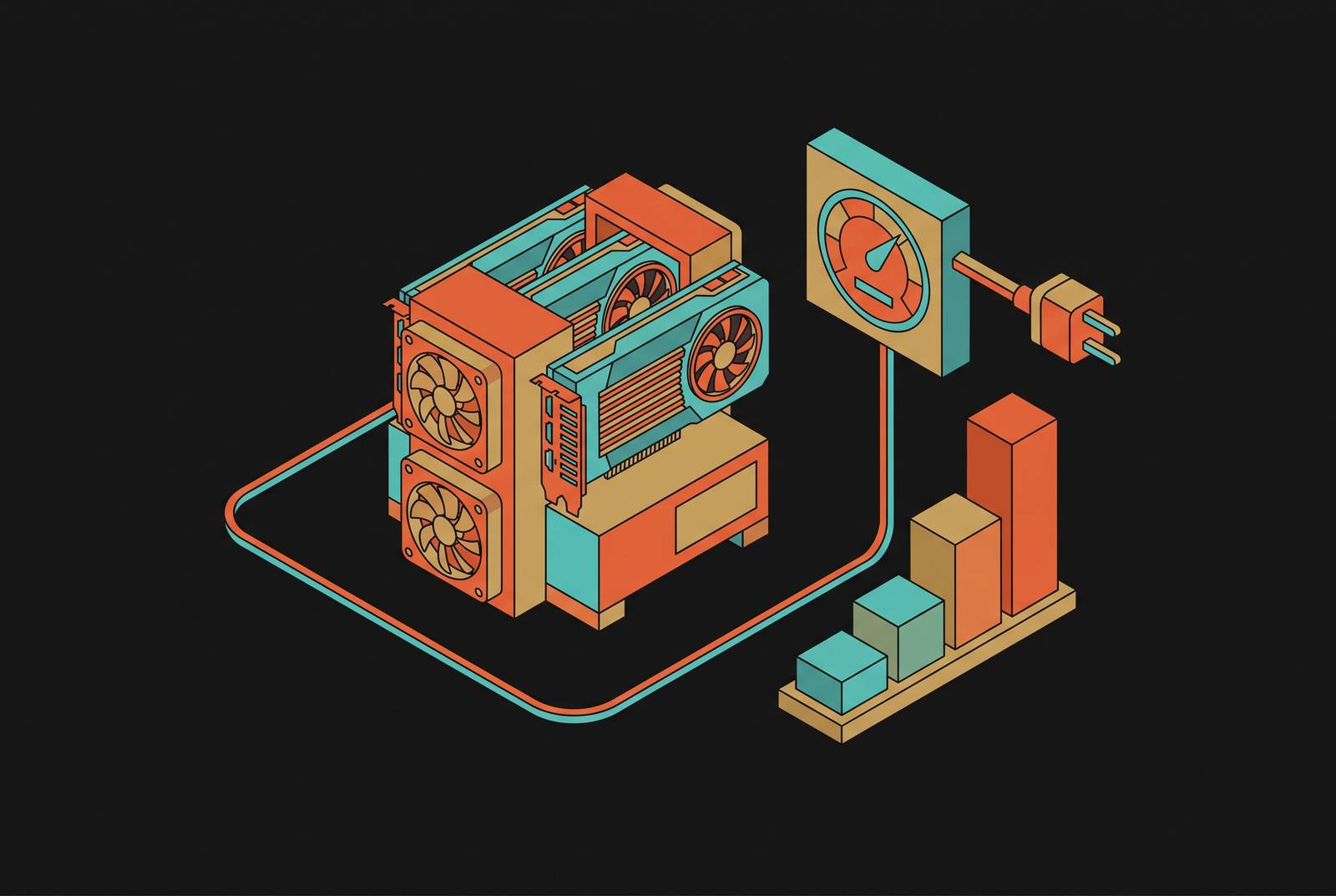
What matters isn't how much inference costs per hour, but what the machine costs every single day it exists, whether it generates one token or a million. Most writing on this topic stops at a GPU wattage number and calls it a day. The real bill comes from three things working together: the hardware tier picked at purchase, how many hours a day the machine sits idle versus working, and the electricity rate on the actual bill. Running a local LLM around the clock costs somewhere between $1 and $30 a month in electricity, and which end of that range a build lands on depends almost entirely on hardware. A 30-fold spread like that is the first clue that hardware tier, not usage habits or which model gets loaded, drives the outcome.
The formula every local AI builder needs before buying anything
Two lines of arithmetic settle almost every question this piece raises, and either one can be run in under a minute with numbers already sitting on a power bill or a spec sheet.
kWh = (average watts × hours) ÷ 1000
cost = kWh × rate per kWh
Take a desktop averaging 250 watts at the wall, running four hours a day, for thirty days, on a rate of $0.16 per kWh. That works out to 30 kWh, which comes to $4.80 a month.
Two inputs feed that formula, and both are trickier than they look. "Average watts" doesn't mean the GPU's spec-sheet TDP. The US averages roughly $0.17 per kWh, Germany runs close to double that, and time-of-use plans can swing twofold between midday and overnight.
Idle power dominates the monthly bill for most users
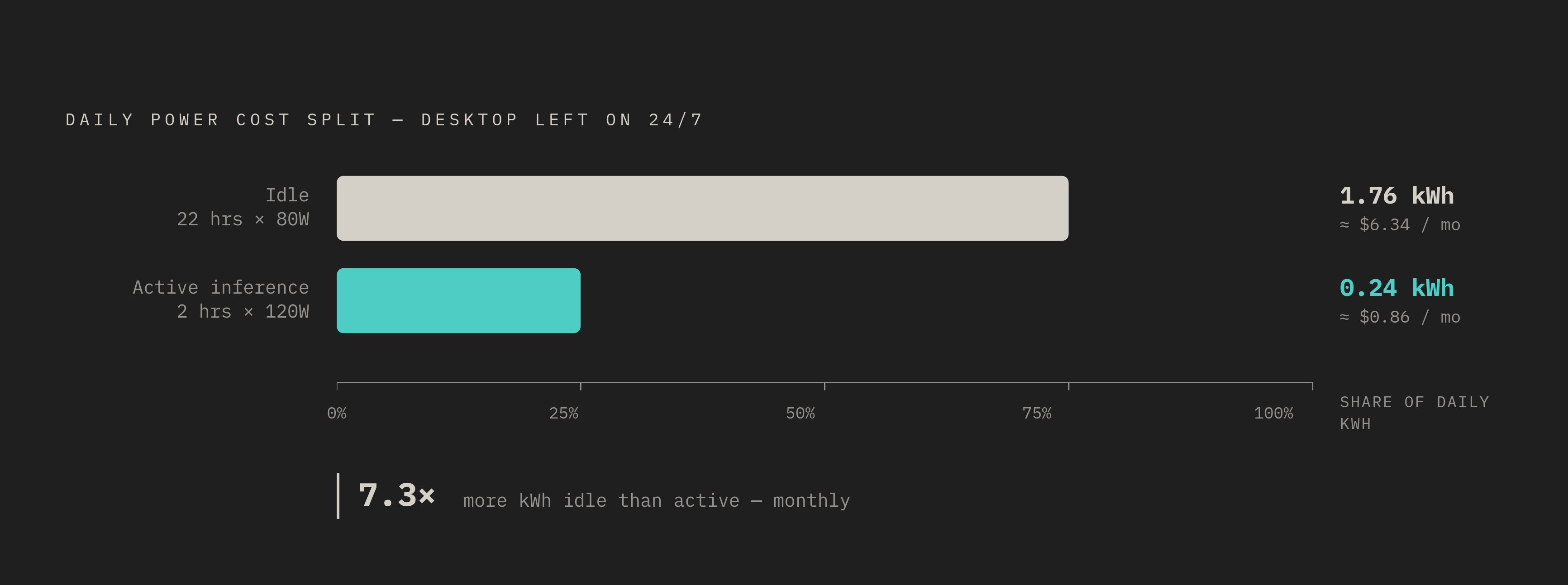
For a machine left on all day, idle wattage multiplied by 22 hours almost always beats out inference wattage multiplied by the two hours spent actually generating text.
Run the numbers on a desktop that idles at 80 watts. Idle alone costs nearly three times what the actual work costs. That tracks with how a personal LLM server actually behaves: the model sits loaded in memory waiting for a prompt more than 95% of the day.
Running an RTX 4090 at 450 watts for two full hours of generation every day adds only about $4.60 a month, less than the idle draw of the very same machine over the other 22 hours.
That changes which habit actually saves money. Power-limiting the GPU helps. Picking a smaller model helps a little. Putting the machine to sleep when it's not in use attacks the largest cost on the bill directly, because idle time is where most of the bill lives.
Whole-system wattage across hardware tiers
Hardware tier sets the entire range this bill can fall into. Whole-system power during LLM inference spans from 20 to 35 watts on a Mac Mini M4 up to 650 watts on an RTX 5090 desktop, a gap wide enough to move the monthly bill by a full order of magnitude.
Apple Silicon is at the efficient end of that range. A Mac Mini M4 idles at 4 to 7 watts and draws 20 to 35 watts under inference load, the strongest option for a machine that stays on all day; its 5-watt idle runs about $0.61 a month at $0.17 per kWh. The Mac Studio M4 Max idles at 6 watts and climbs to roughly 120 to 145 watts under inference, so it can run 70-billion-parameter models at laptop-level power draw. Apple's own M5 Max chip runs 7-billion-parameter models at around 30 watts total, and that makes it something like 10 times more efficient per token than a comparable NVIDIA consumer GPU. The entire Mac Mini chassis, running flat out, draws less continuous power than the board rating of an RTX 4090 alone.
Budget discrete GPUs sit in the next tier up. The Intel Arc B580 runs 190 watts at the board and an estimated 280 to 330 watts whole-system at load, so it's the lowest-power discrete option with enough VRAM (12GB) to handle inference. A PC paired with an RTX 3060 12GB idles at 45 to 60 watts and runs 220 to 280 watts under inference.
Mid-to-high discrete cards push those numbers further. The RTX 3090 runs 350 watts at the board and 440 to 490 watts whole-system, with an idle draw of 60 to 85 watts, high enough that idle becomes a real line item on its own.
High-end cards push well past the mid-range figures under load. The RTX 5090's board alone is rated at 575 watts, with whole-system estimates running 750 to 900 watts.
Workstation-class hardware sits above even that. NVIDIA's RTX PRO 6000 Blackwell carries 96GB of GDDR7 memory and a 600-watt TDP, drawing roughly 270 kWh a month at 50% utilization. Dual-GPU setups, like a PC running two RTX 3090 cards, idle at 90 to 130 watts and climb to 700 to 850 watts under inference; at that range, you need to plan for power infrastructure before you buy the second card.
Whole-system draw always runs higher than a GPU's board rating, for reasons that apply across every tier above. An 80+ Gold power supply runs at roughly 88 to 90% efficiency near half load, and worse at very low load, so you get wall draw by dividing component draw by that efficiency figure. The rest of the machine adds another 90 to 140 watts, covering the CPU during token decoding, RAM, chipset, NVMe drives, and fans, and that number doesn't shrink just because a smaller model gets loaded.
Translating wattage into monthly dollar costs across usage patterns
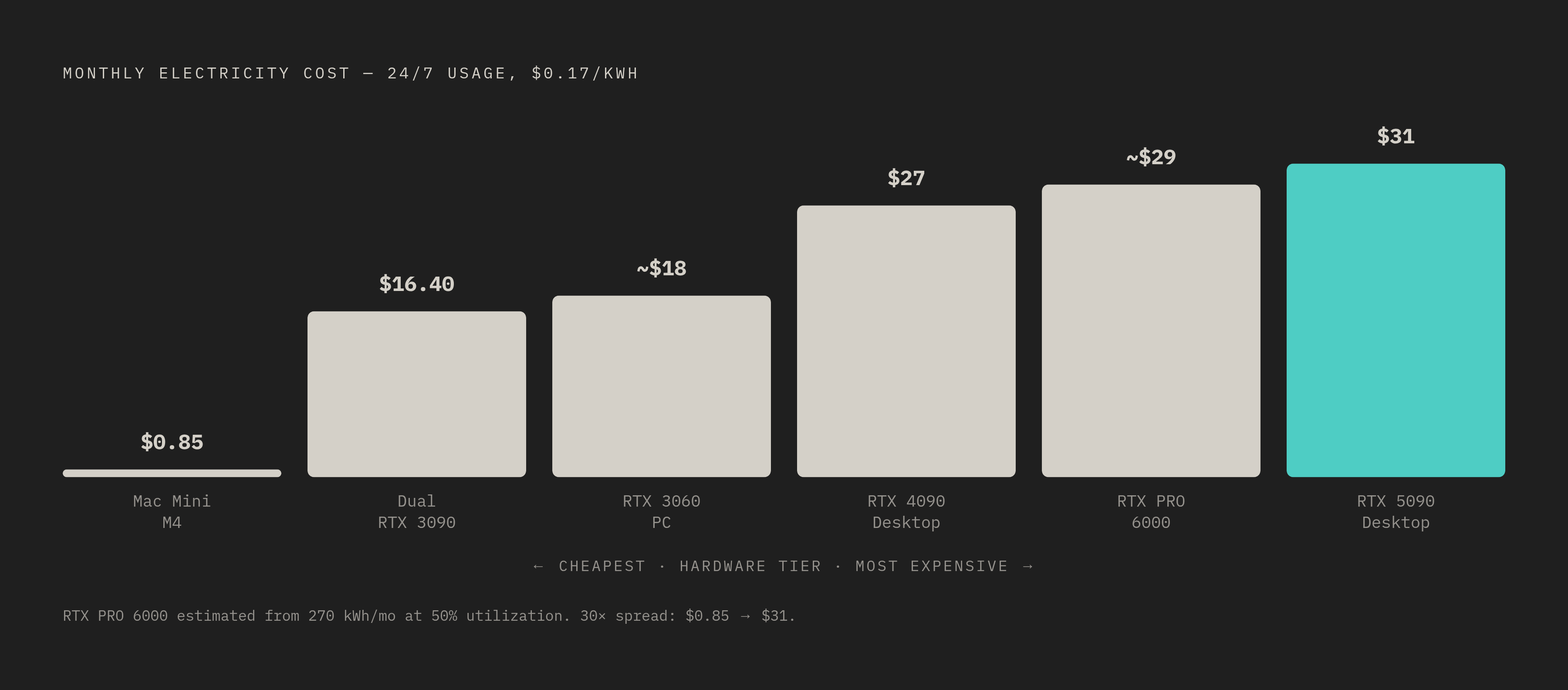
The same GPU can produce very different bills depending on how you use it, and those bills shift again once geography enters the picture. For a machine running 24/7 with 22 hours idle and 2 hours of active inference a day, a Mac Mini M4 runs $0.60 a month at $0.12 per kWh, $0.85 at the US average of $0.17, and $1.50 at a EU-range rate of $0.30. Two RTX 3090 cards together run $11.60, $16.40, and $29.00.
A workstation pattern, 8 active hours and 16 idle hours a day, at $0.16 per kWh, changes the picture again. An RTX 4090 desktop draws 550 watts at load and 70 watts idle, 166 kWh a month, $27.00. An RTX 5090 desktop draws 650 watts at load and 80 watts idle, 195 kWh a month, $31.00.
German rates make the geography point sharply. At €0.35 per kWh with 8 hours of full-load use a day, a Mac Studio M4 Max that averages 70 watts costs €72 a year. Stretch that out three years, and the electricity gap between a Mac and an RTX PRO 6000 system is between €750 and €1,100, a modest sum against a hardware budget but a meaningful share of electricity's total contribution.
The pattern across every table is the same: for machines left running all day, Apple Silicon or a small-form-factor PC beats a tower by a wide margin, and even the pricier RTX 4090 box still costs less per month in electricity than a single ChatGPT Plus subscription.
How model choice and "thinking" features multiply energy consumption
Hardware tier sets the outer boundaries of a power bill, but inside any single tier, the model loaded and whether its "thinking" mode is switched on can swing per-prompt energy use by more than tenfold, a bigger lever than anything covered so far.
The per-prompt numbers spread even wider: qwen3.5:4b with thinking switched on drew 3,590 joules per prompt, more than 36 times higher than qwen2.5:0.5b, despite carrying only 4 billion parameters against the smaller model's claims to efficiency.
Flipping on a reasoning model's thinking feature can push the energy cost per prompt up further than any change in hardware tier would produce on its own. Someone who moves from a small standard model to a 4-billion-parameter reasoning model with thinking enabled might see per-prompt energy use rise more sharply than switching from an RTX 3060 to an RTX 4090 ever would. Parameter count alone says very little about energy use. Whether thinking mode is on or off says a great deal more.
The single highest-ROI optimization: power-limiting the GPU
Token generation is bound by memory bandwidth, not raw compute. Because of that, capping a GPU's power limit cuts electricity draw by a real margin while it barely touches tokens-per-second.
On Linux, the command is:
sudo nvidia-smi -pl 300nvidia-smi --query-gpu=power.draw,power.limit --format=csv -l 5For anyone running a machine 24/7 under heavy use, that cap saves a meaningful chunk of the monthly bill, and it cuts heat output and fan noise in proportion, which makes it as much a comfort and longevity upgrade as a cost one.
Control which hardware a model stays loaded on. Keep models resident on efficient hardware and let them unload on cards that draw heavily when idle. On a headless Linux server, if nvidia-smi shows 40 watts or more at idle with nothing loaded, the card may be stuck in a high power state, and persistence mode or a P-state fix is worth checking.
Quantization, by contrast, does less for power than people expect. Running a model at Q4 versus Q8 changes how much VRAM it needs far more than how much power it draws, since the bandwidth-bound nature of inference means the GPU isn't pushing against its compute ceiling in either case.
What a local rig costs per month beyond electricity
Every number in this piece so far describes a real cost, but on a properly modeled rig, hardware depreciation dwarfs it. Depreciation makes up roughly 85% of the monthly bill for a local build. At US-average commercial power rates and 50% utilization, electricity accounts for only about 13% of total cost of ownership.
Desktop GPU builds typically plan for one GPU upgrade around year four or five, but Mac and laptop builds have no upgradeable parts at all, so the only lever you have later is buying the maximum memory configuration available at purchase. Stretch a 3-year depreciation schedule out to 5 years, and both the monthly cost and the utilization needed to break even drop, following the same formula laid out earlier in this piece.
How geography and rising baseline rates change these calculations
Every dollar figure in this piece rests on a kWh rate, and that rate is climbing for reasons tied directly to the AI buildout this piece is about. The US averages roughly $0.17 per kWh today, Germany runs close to double that, and time-of-use plans can swing twofold between midday and overnight. Some formulas in circulation still use a lower per-kWh baseline, but current EIA data puts the US commercial average noticeably higher.
Residential rates have moved further still. The EIA's Electricity Monthly Update puts average US residential cost at 17.45 cents per kWh, up 9.5% year over year. Since 2020, residential rates have climbed more than a third, from 12.76 cents per kWh to 17.44 cents per kWh in February 2026, and the trend points further upward.
Geography shifts the local-versus-cloud math more than any hardware choice within a given tier. Moving from US average electricity to EU rates pushes the daily token volume needed to justify local hardware up by 40% to 60%.
The AI data center buildout connects directly to these rising rates. Residential electricity prices jumped more than double the inflation rate in 2025, topping 20% in some states according to federal data. In the PJM electricity market, the price for capacity rose sharply in a recent auction, and an independent monitor's report attributed about three-quarters of that jump to data center demand. Run any cost calculation in this piece off the actual rate on a current bill, not a national average, and look at it again every year as rates keep climbing.
When local hardware beats cloud APIs on cost
Local hardware can beat premium cloud API pricing once utilization crosses a certain threshold, but commodity inference pricing is a different fight, and sub-dollar-per-million-token providers are already winning it.
The break-even math is straightforward: monthly local cost equals depreciation per month plus electricity at whatever utilization rate applies, and monthly cloud cost equals tokens processed per month times the price per million tokens, divided by a million.
Commodity inference providers running the same open-weight models already charge around $0.88 per million tokens, and local hardware can't reach that price no matter how you structure the depreciation schedule. At 20% daily utilization, an RTX PRO 6000 costs more per million tokens than Claude Sonnet, but if you push utilization to 50%, the local build drops comfortably below it. At 20 million output tokens a month, DeepSeek V4 Flash costs $2.80 total, and local hardware has no way to match that.
A rough rule of thumb: spend more than $200 a month consistently on API tokens, and local hardware tends to break even within 12 to 18 months. Offline, batch, non-interactive workloads tend to favor the cloud no matter what local hardware you have, since batch API pricing undercuts almost anything running at home.
The strongest case for local hardware in 2026 is about control, not cost. Running inference on-prem removes the third-party data-processing surface that GDPR and the EU AI Act make expensive to maintain for medical, legal, financial, and government workloads. Privacy, data residency, and the ability to run fully offline are the durable reasons to build a local rig. Economics are the exception case, not the rule. When AI is meant to support human judgment directly, keeping sensitive reasoning on a device under a practitioner's own control makes a case that never has to touch a token-pricing spreadsheet.