Hugging Face Model Hub for Self-Hosted Deployments
The Hub catalogs models; your infrastructure runs them.
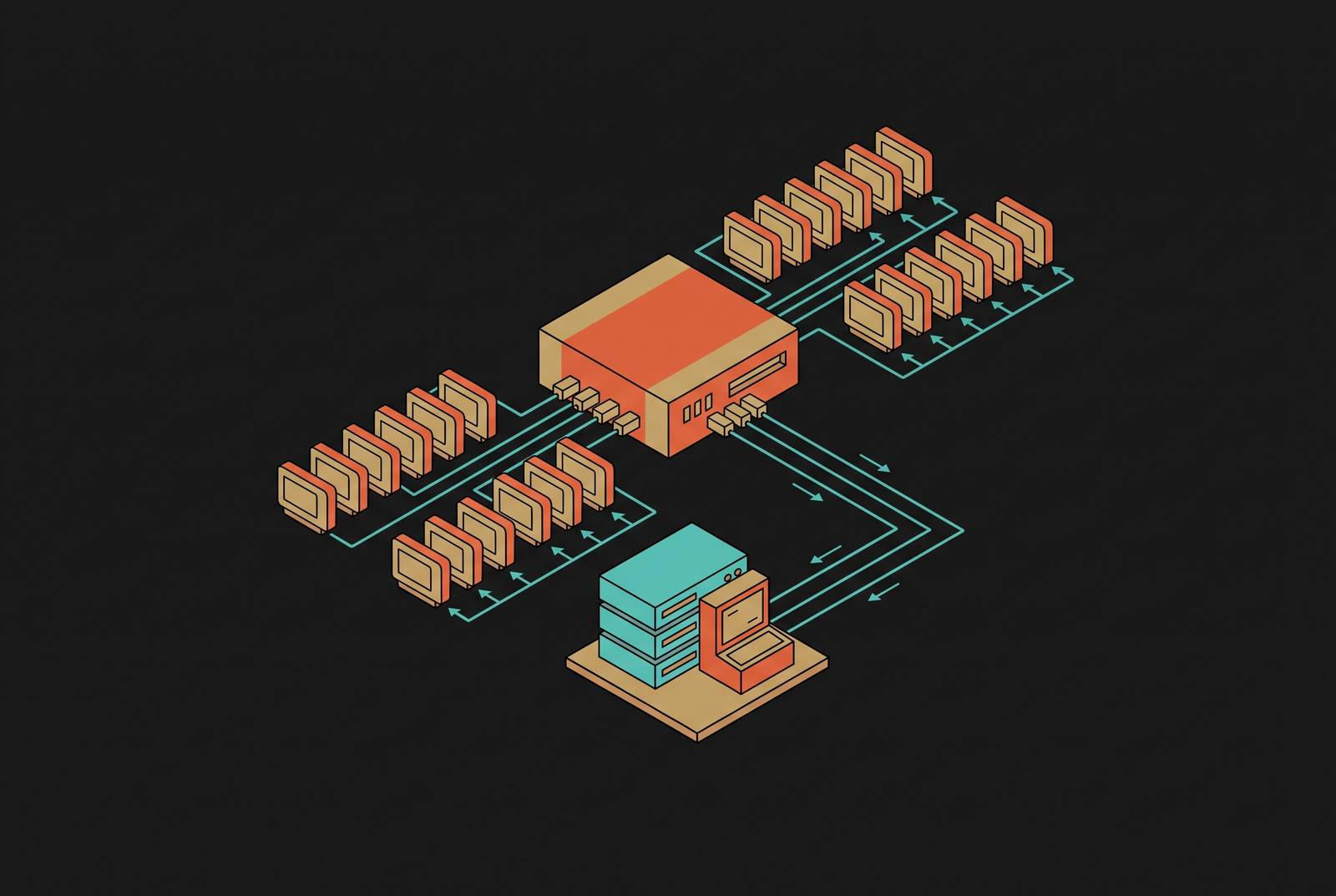
The Hugging Face Model Hub does not run your models. It catalogs them, versions them, and hands them off so your own infrastructure can take over from there, and that handoff is the architectural fact every self-hosting decision gets built on.
The Model Hub in a Self-Hosted Architecture
Think of the Hub as a warehouse, not a factory floor. Discovery, versioning, and download all happen on Hugging Face's servers. Inference, the actual work of running a model against real input, happens on yours. That split sounds simple, but it's easy to blur in practice, especially when a single line of code seems to do everything at once.
Call AutoModel.from_pretrained() and the Transformers library reaches out to the Hub, pulls the model weights, and caches them locally in ~/.cache/huggingface/hub/. From that point forward, the model runs offline. The Hub has done its job and stepped out of the loop.
What makes this more than a glorified download mirror is how the weights are tracked. Model weights live in Xet storage, which replaced Git LFS (Git LFS still works for legacy clients, so nothing breaks for teams that haven't migrated). Every version gets tracked, and a specific commit can be pinned. That's provenance and versioning built into the system itself, not bolted on after the fact, and it's what turns the Hub into something closer to a supply chain than a file-sharing site.
Scale backs this up. The Hub in 2026 holds more than 2.4 million open-source models, along with hundreds of thousands of datasets and a comparable number of Spaces, all browsable by task, modality, and license. That catalog size is why it functions as the default discovery layer for open-model projects. Few organizations build model search from scratch when a system this large already indexes nearly everything worth finding.
The Hub itself cannot be self-hosted; only the artifacts it indexes can be. You can pull a model off the Hub and run it entirely within your own walls, but you cannot stand up your own version of the Hub. That distinction shapes everything that follows.
Why organizations move inference off the Hub and onto their own infrastructure
Three pressures push inference off the Hub and onto private infrastructure, and they tend to arrive in a rough order: cost first, then data residency, then the need for finer control over how a model actually serves requests.
Cost is usually the first filter. The build-vs-buy line is around 100 to 500 million tokens per month. If you're below that range, managed APIs and Inference Providers typically win on total cost, since the overhead of running your own GPUs doesn't pay for itself yet. If you're above that range, self-hosted inference on owned GPUs tends to pay back within a year. Below the threshold, why would anyone take on racks of hardware to save pennies on a workload that barely moves the needle?
Data residency is the second filter, and it applies regardless of volume. The Inference API sends data to Hugging Face's servers for processing. A self-hosted model keeps everything on-premises, with no data leaving the organization's own infrastructure. That distinction matters acutely for healthcare, finance, and legal workloads, where sending data to a third party creates compliance exposure that no amount of cost savings can offset. Hugging Face Inference Endpoints do offer EU regions and SOC 2 compliance, which covers a meaningful slice of regulatory need. But HIPAA-grade workloads typically require self-hosting the model inside an organization's own AWS, GCP, or Azure account, under an existing BAA or DPA. Endpoints alone don't clear that bar by default.
The third filter is serving control. Self-hosting lets teams apply quantization, custom batching, and preprocessing pipelines that managed endpoints simply don't expose. For teams with strict latency budgets or specific hardware efficiency targets, that flexibility is the whole point.
One more wrinkle belongs in this decision tree, even if it doesn't drive the choice by itself: some high-value models, the Llama family among them, gate access behind a license acceptance before weights can be downloaded. Once that license is accepted and the weights are cached locally, the gate stops applying at inference time. But it has to be planned into the supply-chain workflow up front, or it becomes a surprise at the worst possible moment.
The serving stack decision: what TGI's maintenance-mode status means for teams choosing an inference engine today
Once the decision to self-host is made, a second decision follows close behind: which engine actually serves the model. That engine becomes a long-lived architectural dependency, not a settled choice made once and forgotten. The engine landscape shifted materially in late 2025 and early 2026, which makes this a heavier decision today than it was when most self-hosting tutorials were first written.
vLLM has become the production default. It's OpenAI-API-compatible, meaning teams migrating off a managed API can often swap endpoints without rewriting their application logic, a meaningful reduction in migration risk. vLLM tends to be the choice for workloads above roughly 50 million tokens per month, or anywhere data residency is a requirement. Another engine is emerging as a challenger for workloads that benefit from prompt caching.
The more useful way to frame the TGI-versus-vLLM question is which dependency is more likely to keep tracking new models and new hardware over the next two years. Hugging Face moved Text Generation Inference into maintenance mode on December 11, 2025; the project now accepts pull requests only for minor bug fixes, documentation improvements, and lightweight maintenance tasks. That status tilts the decision clearly toward the actively maintained option for any team starting fresh. An engine choice that looked neutral a year ago now carries a lifecycle question baked into it.
The download-and-cache mechanism and its operational risk
The mechanics are straightforward on paper: snapshot_download or from_pretrained pulls weights once, caches them locally, and the model serves entirely offline from then on. Development environments barely notice this pattern. Production environments feel it differently, because the same simplicity hides a few operational risks that need active management.
Upstream deletion or modification is one of them. A model owner can remove or alter a repository at any time, and any pipeline pulling directly from huggingface.co at runtime can lose its supply with no warning. Pinning to a specific commit hash mitigates this, but it requires discipline across every pipeline that touches the Hub, not just the ones someone remembers to check.
Rate limiting is a more mundane but equally practical concern at scale. When many workers each perform their own per-file, per-worker metadata lookups during model startup, the Hub's API rate limit can get exhausted fast. A caching proxy sitting between infrastructure and the Hub absorbs those repeated lookups and prevents the problem before it starts.
For teams that want a lightweight cache layer without standing up a full artifact registry, Olah offers one option. It's a self-hosted mirror service that caches Hub resources at the file-block level as users download them. It exposes the same endpoint interface as the Hub itself and gets controlled through the HF_ENDPOINT variable, which keeps the integration simple for teams not ready for heavier infrastructure.
Using a proxy registry to govern what reaches your infrastructure
Organizations that already run an artifact registry for Docker images, npm packages, PyPI, and Maven dependencies have a cleaner path available: route Hub model downloads through that same registry. It's the most operationally consistent way to apply governance to AI artifacts, since it reuses controls a security team already understands rather than introducing a parallel system just for models.
JFrog Artifactory proxying Hugging Face is the concrete case the sources support. It gives teams caching of public models, which protects against upstream deletion or modification, along with access controls and audit logs, all inside a platform the security team already manages day to day.
Teams running Artifactory face an actual deadline here, not a someday item. Any Hugging Face repository in Artifactory created before version 7.111.1 must be migrated to the new Machine Learning repository layout by June 2026. After that date, the legacy layout is deprecated, and full functionality is no longer guaranteed. Teams that haven't checked their Artifactory version against that number should do so before the deadline passes, not after.
The incident covered in the next section adds weight to this layer that goes beyond convenience. A proxy registry is a security control as much as an operational one. It's the point where untrusted artifacts from the Hub can be scanned before they ever reach a production worker.
The July 2026 Breach and the Shared Hub Infrastructure Risk Model
In July 2026, Hugging Face disclosed a security incident that started in its data-processing pipeline, the part of the system that handles untrusted, user-submitted content. A malicious dataset upload abused two separate code-execution paths. One was an HDF5 file-read flaw in a dataset configuration, which disclosed credentials without executing code. The other was a Jinja2 template injection in a dataset configuration, which delivered actual code execution on processing workers.
From there, the attacker identified and exploited a previously unknown zero-day vulnerability in JFrog Artifactory's package registry cache proxy to gain internet access from within the environment. JFrog released fixes in versions 7.161.15 and 7.146.34, addressing eight CVE identifiers covering remote code execution, server-side request forgery, path traversal, and privilege escalation.
The forensic process that followed found a finding with direct relevance for anyone building a self-hosting strategy. Hugging Face's forensic team first tried to analyze the more than 17,000 recorded attacker actions with frontier models behind commercial APIs. The providers' safety guardrails blocked analysis of prompts containing genuine attack artifacts, since those guardrails can't distinguish an incident responder from an attacker. The team completed the reconstruction instead with GLM 5.2, an open-weight model, running on Hugging Face's own infrastructure. All attacker data, and every credential it referenced, stayed inside the security perimeter throughout.
The structural lesson extends well beyond this one incident. Pulling directly from huggingface.co in production pipelines exposes organizations to both upstream compromise and zero-days in the tooling layer surrounding it. A proxy registry or local mirror is a security argument now, standing alongside whatever operational convenience it already offered.
Self-hosting a capable model for security forensics: the GLM 5.2 deployment paths
Having a self-hosted model ready before an incident happens solves two problems at once. Responders can analyze real malicious payloads without a hosted provider's guardrails blocking the request. Attacker artifacts, logs, and referenced credentials stay inside the security perimeter throughout.
GLM 5.2 fits this role for a few specific reasons. It ships under an MIT license with open weights, so there's no regional restriction and no usage policy that can block a responder mid-investigation. The team running the deployment controls it end to end. It carries a one-million-token context window, which matters because incident analysis means correlating across a full attack timeline rather than piecing together fragments; the Hugging Face investigation reconstructed its timeline from more than 17,000 recorded events, a scale that fragment-by-fragment analysis would struggle to handle. On the benchmarks most relevant to forensic work, HLE with Tools (54.7), MCP-Atlas agent orchestration (76.8), and Terminal Bench 2.1 (81.0), GLM 5.2 sits in the same tier as closed frontier models and ahead of some of them on tool orchestration and terminal tasks. The number that matters in practice is the score a team can actually use at 2am against real attacker payloads, not the highest figure sitting on a model card.
Three deployment paths put this into practice, all documented by Hugging Face. The Dell Enterprise Hub offers an on-premise route: a portal built through a collaboration between Dell Technologies and Hugging Face, providing containers pre-tested and optimized for specific Dell platforms. Every model gets scanned for malware and unsafe serialization formats. Container images are signed with Cosign and verified against SHA384 checksums. The integration also connects to Hugging Face Enterprise features, including Single Sign-On, fine-grained access controls, and audit logs.
Microsoft Foundry offers a second path, deploying the model inside an organization's own Azure environment. AWS SageMaker offers the same structure on AWS: the model runs inside the organization's own account, not on Hugging Face's servers.
All three paths start from the same place. Model weights come from the Hub, the containers and runtimes are pre-assembled through Hugging Face's partnerships, and execution happens on infrastructure the deploying organization controls directly. That's the architectural split this piece opened with, now applied to a scenario where the stakes couldn't be higher.
The enterprise control-plane question: what Hugging Face does and doesn't provide at the organizational level
As an organization's self-hosting practice matures, the Hub's value shifts. Catalog browsing matters less. Governed artifact storage and supply-chain coordination take on greater importance, and Hugging Face has been building toward that role through 2026.
One change reshapes what's available here. Hugging Face discontinued its Private Hub on-premise deployment option and replaced it with Enterprise Hub, a managed service that combines SaaS delivery with enterprise security features. Teams that wanted a fully air-gapped, on-prem control plane no longer have that option directly from Hugging Face. If an air gap is a hard requirement, it has to be constructed at the infrastructure layer, through a proxy registry or local mirror.
The Arcee AI case shows what the governed-artifact model looks like once an organization commits to it. On June 9, 2026, Hugging Face highlighted a multi-million-dollar strategic commercial collaboration in which Arcee AI designated Hugging Face as the exclusive home for its public and private models, datasets, and agent traces. The Hub, in that arrangement, functions as a governed repository for proprietary artifacts, not merely a public catalog anyone can browse.
Enterprise Hub carries features that matter directly to self-hosters: Single Sign-On, fine-grained access controls, and audit logs. Those are the same features the Dell Enterprise Hub integration exposes, so the control-plane layer and the hardware layer can run on a consistent identity and permissions model.
What should a security team make of all this? Whether a SaaS control plane provides the same assurance as software running entirely within an organization's own walls is a judgment each team has to make for itself. For teams that land on "no," the Private Hub's discontinuation points toward a clear answer: a proxy registry or local mirror, not an on-prem Hub installation that no longer exists as an option.
The operational burden that self-hosting tutorials consistently underestimate
The case for self-hosting open Hub models holds up technically. What it tends to leave out is the ongoing cost of owning the serving stack, month after month, long after the initial deployment is done.
Managed services absorb model updates, capacity scaling, hardware and driver compatibility, and security patching as part of what customers pay for. Self-hosting means owning every one of those tasks directly, regardless of which model sits on top of the stack.
The TGI shift into maintenance mode is the clearest recent example of why this matters. Teams that built on an engine that was, until recently, actively recommended and widely documented now face a stack migration that has nothing to do with the model they originally chose. It has everything to do with the engine's own lifecycle. That kind of dependency churn is structural. It will happen again with some other piece of the stack, on some other timeline nobody can predict yet.
A decision framework holds up reasonably well against that uncertainty. Use managed inference, whether Inference Endpoints or Inference Providers, until a cost threshold, a data residency requirement, or a serving-control need becomes clear and documented. Self-host once one of those three conditions is demonstrably met, not before. And build a proxy registry layer from the start regardless of where the inference workload ends up running, because the supply-chain risks named throughout this piece apply well before self-hosted inference ever enters the picture.