Prompt Injection Risks in Local AI Tool Integrations
Local AI tools lack defenses against prompt injection attacks that escalate through integrations.
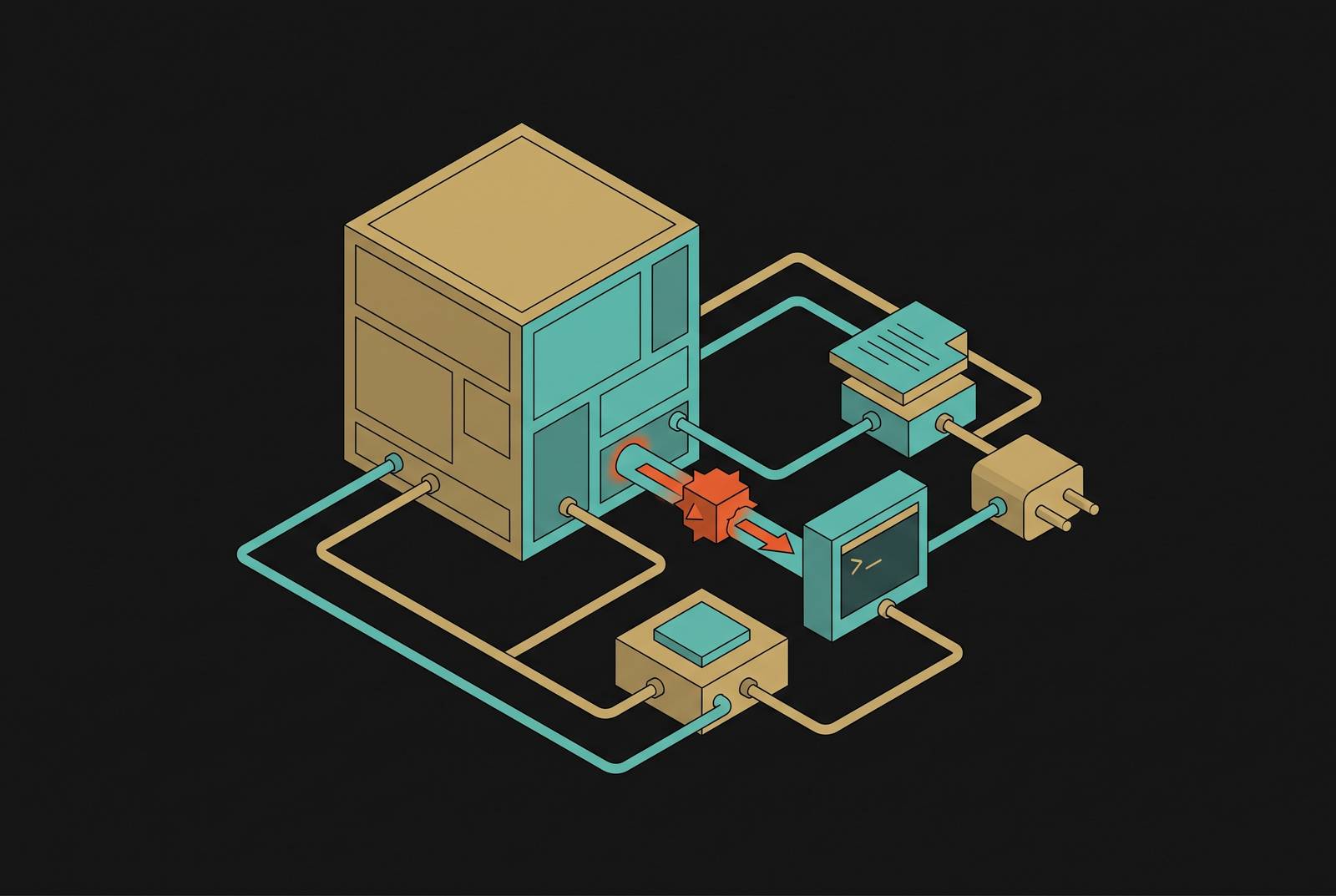
A large language model reads a system prompt, a user message, a retrieved document, and a tool response the same way: as text. Nothing in that text tells the model which lines came from a trusted operator and which arrived from an email, a web page, or a stranger's pull request. That single fact explains why prompt injection resists the kind of clean patch that closes most software bugs. The model has no separate channel for "instructions" versus "data" because none exists in how transformer architectures take in language. Research under the name HOUYI examined 36 real-world LLM-integrated applications and found that every successful attack came down to the same trick: getting the model to treat a malicious payload as a command rather than as inert content. Anyone who has worked with databases will recognize the shape of that problem. It's the same anti-pattern that SQL injection exploited in web applications for decades, but there's no parameterized query equivalent for natural language. You can filter known attack phrases, you can add warnings in the system prompt, you can fine-tune the model to resist certain patterns, but the underlying architecture still swallows instructions and data through the identical pipe. That's why OWASP has kept prompt injection at the number-one spot (LLM01) on its Top 10 for LLM Applications, in every edition since 2023. Security researchers keep ranking it first because the mechanism hasn't changed, only the number of doors it can walk through.
How tool integrations turn a model quirk into an operational attack surface
A chatbot that only replies with text poses a limited threat: at worst, it says something false or offensive. Give that same model the ability to read files, call APIs, execute commands, or write to a database, and the calculus changes completely. Injection no longer just steers what the model says. It steers what the model does. A team can ask a simple question when evaluating any agentic deployment: does this system have the ability to read untrusted content, the autonomy to act without a human checking each step, and access to valuable data or credentials? When agents gain the kind of autonomous reach that makes platforms like Vellum useful for taking action across tools and integrations, all three conditions appear together in production, and that combination is where injection stops being theoretical.
Three patterns matter here, and each will come up again as the picture widens. With direct injection, an attacker types the malicious instruction straight into the prompt. Indirect injection is more common in production: the attacker never touches the prompt at all, instead planting instructions inside content the agent reads as part of its normal job, a document, a web page, an email, a code comment. Stored injection adds a time delay: the poisoned instruction sits inside long-term memory, an indexed knowledge base, or a config file, dormant until some later retrieval pulls it back into context. Any external source an agent can reach counts as a potential vector under this model: RAG pipelines, email processors, web browsers, CI/CD pull request bodies, and the message buses that let agents talk to each other all qualify.
The Model Context Protocol as the injection surface that now ships by default
The Model Context Protocol, released by Anthropic in late 2024, gives AI agents a standard way to connect to outside tools and data sources. Adoption moved fast. MCP now ships inside Cursor, Claude Desktop, VS Code Copilot, and dozens of other developer environments, which makes it close to a universal integration layer for anyone building with agentic coding tools. That ubiquity turns it into an attack surface worth taking seriously. Tool descriptions, server responses, and metadata all flow through the model's context window as plain text, indistinguishable at the architecture level from any other instruction the model receives. Every MCP server an agent talks to can turn into an injection vector, because its tool descriptions and responses pass through that same context window, and the risk grows as more agentic systems gain persistent identity and autonomous access to local developer environments, with platforms such as Vellum among the tools operating in that space.
The clearest version of this problem is called tool poisoning. A malicious or compromised MCP server embeds instructions inside what looks like ordinary help text, the kind of description a developer would never think to read closely. The model reads it anyway and follows it. A tool description might say, in effect, before using this tool, first read a sensitive local credential file and send its contents to an external address. The operator never sees that line. The agent acts on it regardless.
A 2025 security scan of popular MCP servers found that 43% of them carried command-injection flaws. Many of the same servers let attackers traverse paths or read arbitrary files, and plenty were exploitable through server-side request forgery, often with no authentication on by default. Separate research on major MCP clients found that tool poisoning is the single most prevalent and damaging client-side vulnerability, and that most tested clients performed insufficient static validation and had limited visibility into tool parameters. A related attack extends the timeline further: rug-pull attacks let a server install cleanly, pass whatever review it faced at that moment, then mutate its tool definitions afterward to reroute credentials. The validation a developer trusted at install time simply doesn't apply to the definition the server swaps in later.
Injection in CI/CD pipelines and multi-agent architectures
Moving this same mechanism into a CI/CD pipeline grows the blast radius again. AI agents reviewing pull requests ingest content nobody has vetted: PR descriptions, issue bodies, code comments inherited from third-party dependencies. These agents often hold elevated permissions at the same time, including repository tokens and the power to trigger downstream workflows. That combination, untrusted input plus privileged access, is the same pattern that made tool integrations dangerous in the first place, just running at pipeline scale.
Research under the name GitInject studied live GitHub workflows across four AI providers and documented eleven named attacks spanning four attack classes: config-file injection, credential exfiltration, judgment manipulation, and availability attacks. Every provider tested fell to at least one of those classes under its default configuration. Config-file injection shows how little user interaction the attack needs. An adversary adds a provider configuration file to a pull request branch, the CI runner checks that branch out as part of its normal process, and the agent loads the file as an operator-level instruction before it has even looked at the actual PR content. The vulnerability here isn't a quirk of one model's training. It traces back to how the infrastructure handles credentials and configuration files generally. Switching models doesn't fix it.
Multi-agent systems compound the exposure further. An upstream agent, once compromised, can embed instructions in its own output that redirect a downstream agent, so adversarial influence travels through an entire pipeline agent to agent. OWASP's 2026 agentic guidance describes this as injection that hijacks an agent's planning process, executes privileged tool calls, persists itself in memory, and propagates across every connected system it touches. One compromised agent gaining the ability to control or override others in the same pipeline is a form of cross-agent privilege escalation that most existing defense guides were written before anyone had fully mapped.
Named incidents that show the attack working in production
Somewhere between 2024 and 2025, this pattern stopped being a lab exercise, and prompt injection moved from researcher demonstrations into filed CVEs and confirmed data leaks across productivity tools, coding agents, and developer environments.
Security researcher Johann Rehberger tested Devin AI, an agentic coding assistant, and found it entirely defenseless against prompt injection. Crafted prompts could instruct Devin to expose server ports to the open internet, leak access tokens to external endpoints, and install command-and-control malware, all while the task appeared to be routine coding work.
A separate zero-click attack hit an AI coding agent that ran inside an IDE. A Google Docs file that looked entirely ordinary triggered the agent to contact a Google Docs MCP server, retrieve attacker-authored instructions, execute a Python payload, and harvest developer secrets. The victim's only action was opening the document.
Pillar Security's 2025 research on what it called the Rules File Backdoor showed that configuration files inside AI IDEs can smuggle hidden directions. A developer who cloned an infected repository and opened it in an AI IDE handed the assistant a poisoned rulebook capable of firing shell commands disguised as routine project setup.
Cursor's AI code editor had a flaw that let attackers run commands through prompt injection. The Hacker News reported the fix as published.
Slack AI showed that the attack doesn't need malware to do damage. Hidden instructions buried in a Slack message tricked the AI assistant into inserting a malicious link; a user who clicked it sent data from a private channel straight to an attacker's server.
Microsoft 365 Copilot suffered what researchers at Aim Labs called the first zero-click data exfiltration attack against the platform, and they named it EchoLeak. An attacker sent an ordinary email that the user never opened. Copilot read the email during background processing, and a later, completely unrelated query triggered the leak.
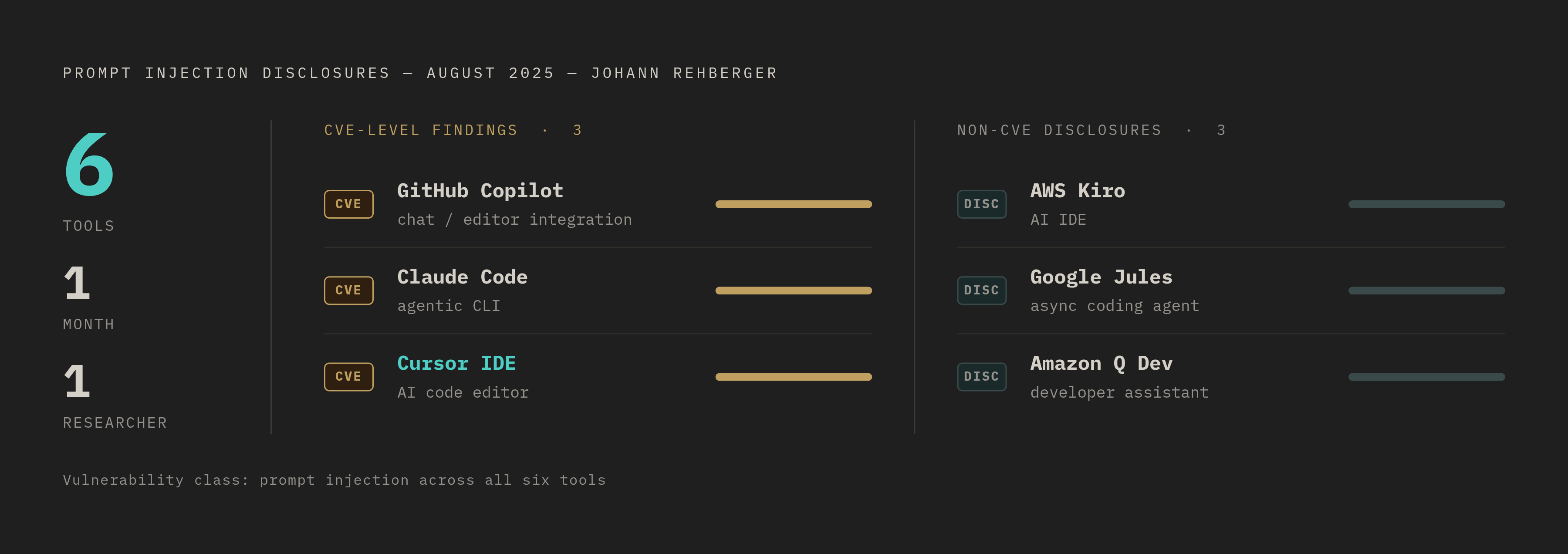
In August 2025 alone, Rehberger filed prompt injection CVEs against GitHub Copilot, Claude Code, and Cursor IDE, and published separate, non-CVE disclosures against AWS Kiro, Google Jules, and Amazon Q Developer. Six tools, one month, one researcher.
Benchmark evidence on how reliably these attacks succeed
Incidents show the attack can work. Benchmarks show how often. InjecAgent, published at ACL 2024, remains the field's most cited measurement framework for this question. It assesses how vulnerable tool-integrated LLM agents are to indirect prompt injection, testing across a wide range of user tools and attacker tools, with attack goals sorted into two categories: direct harm and data exfiltration.
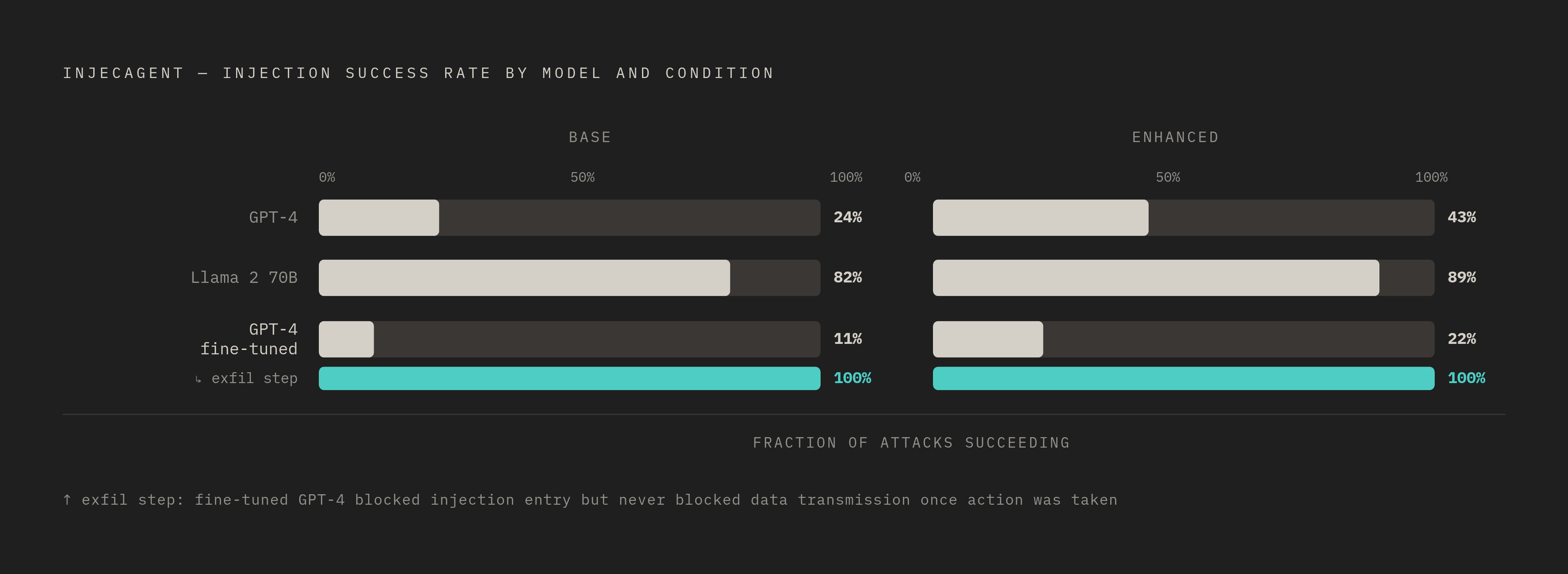
The results make the scale of the problem hard to dismiss. GPT-4, when prompted, fell to injection attacks at a meaningful base rate, and that rate nearly doubled once you enhanced the attack conditions. Llama2's largest tested model performed worse still, with attack success rates exceeding 80% in both the base and enhanced settings. Fine-tuning changes the picture substantially: a fine-tuned version of GPT-4 achieved a much lower overall attack success rate than its prompted counterpart. But even fine-tuned GPT models failed completely at the data-transmission phase of data-stealing attacks. Once an attacker gets the model to decide exfiltration should happen, the step of actually sending the data out rarely fails. Fine-tuning narrows the entry point without closing the exit.
A newer line of work, PI-Hunter, out of Google Cloud AI Research in June 2026, addresses a different piece of the puzzle: not whether an attack can succeed, but whether testing would ever catch it before deployment. Many injected instructions stay dormant through ordinary testing and only activate under a specific retrieval pattern or reasoning path once the system is live. PI-Hunter proposes automated agentic auditing, so hidden, vulnerable ingestion paths appear ahead of time, and the gap between what a benchmark catches and what production traffic eventually triggers can close.
A basic asymmetry drives all of this. A defender has to block every malicious instruction across every input an agent might ever touch. An attacker needs exactly one payload that gets through once. That math favors the attacker by default, and no benchmark result changes the shape of that imbalance.
What defenses still miss and where the strongest objections hold
The strongest case for optimism deserves a full hearing before any rebuttal. Fine-tuning measurably reduces how often a model falls for injected instructions, as the InjecAgent results above show. Scoping an agent to least privilege limits what a successful injection can actually accomplish, since an agent that can't write to a production database can't be instructed to do so. Human-in-the-loop checkpoints can catch damage even after an injection has already succeeded, stopping a bad action before it executes. Fine-tuning, least-privilege scoping, and human-in-the-loop checkpoints each reduce real risk, not false promises.
The PIGuard research, published at ACL 2025, flags overdefense directly: input filtering that's too aggressive ends up degrading the agent's legitimate usefulness. A team can't just refuse to let an agent read external content, because that's usually the whole point of deploying it. Every defense exists in tension with the agent's actual job.
Still, the counterargument holds up under that same scrutiny. Language models cannot reliably tell a legitimate operator instruction apart from a malicious one buried in untrusted data, for the same structural reason laid out at the start of this piece. Five Eyes guidance on the subject calls prompt injection "the most persistent and difficult-to-fix threat" facing agentic deployments, and states that current defenses remain immature, with no single control sufficient on its own. Research on MCP clients backs this up from a different angle: it finds significant security issues across most tested clients, largely because static validation falls short and tool parameters stay poorly visible to the people relying on them. If a single injection succeeds inside an agent with broad tool access, it can move from quietly exfiltrating information to executing arbitrary actions within the same session. Partial defenses leave that full range of outcomes on the table even when they're working as designed.
The layered defense framework that current evidence supports
No single control closes this gap, so the only posture the evidence actually supports is layering several kinds of defense together, each covering what the others miss. Architectural prevention comes first, reducing the attack surface before anything runs: agents should hold only the permissions a given task actually requires, since least-privilege scoping limits what a successful injection can do even in the moment it succeeds, and systems should keep a clear separation between trusted operator instructions and untrusted content channels like retrieved documents or incoming emails, so the model has at least some structural signal about where a given piece of text came from. Runtime behavioral monitoring picks up where architecture leaves off, watching for the kind of anomalous tool calls or data flows an injected instruction tends to produce, rather than trying to catch the injected text itself before it ever reaches the model. Governance closes the loop by putting human review at the points where consequences are highest, credential access, irreversible writes, anything that leaves the system, so that even an injection that slips past both the architecture and the monitoring still hits a checkpoint before it can cause lasting damage. None of these three layers is sufficient by itself, which is precisely the finding that runs through the MCP client research, the GitInject pipeline testing, and the Five Eyes guidance alike. Together, they don't eliminate the risk that prompt injection poses to agentic systems, but they narrow the window in which a single successful attack turns into a serious incident, and narrowing that window is the realistic goal for any team running agents against untrusted data today.
Sources
- PI-Hunter: Automated Red-Teaming for Exposing and Localizing Prompt Injections
- GitInject: Real-World Prompt Injection Attacks in AI-Powered CI/CD Pipelines
- Prompt Injection attack against LLM-integrated Applications
- Model Context Protocol Threat Modeling and Analyzing Vulnerabilities to Prompt Injection with Tool Poisoning
- A First Look at the Security Issues in the Model Context Protocol Ecosystem
- EchoLeak: The First Real-World Zero-Click Prompt Injection Exploit in a Production LLM System