Mistral Small vs Qwen2.5 for Multilingual Local Use
Qwen2.5 outperforms Mistral Small for most multilingual local deployments.
Two open-weight model families keep coming up in serious conversations about local, multilingual deployment: Mistral Small, out of Paris, and Qwen2.5, out of Alibaba. Both run commercially under Apache 2.0, with one exception below, and both run well on consumer hardware. But if you're actually deploying one of these on real infrastructure, the honest answer is that Qwen2.5 is the safer default for most teams, and Mistral Small only wins in a narrower set of cases than its marketing suggests.
The choice between these two families for teams running models locally
Local deployment means something specific here: no API calls, weights sitting on a machine someone owns, no data leaving that machine. That's a different risk profile than calling a hosted endpoint you can swap out next quarter. Once you provision the server, you've locked in an architecture, a memory footprint, and a language profile, and none of those are easy to walk back.
Multilingual work raises the stakes further. A model that stumbles on Turkish, or drifts into English mid-sentence during a Vietnamese conversation, isn't something you patch with a clever system prompt. There's no swapping to a bigger model mid-session when you're running locally. The GPU bolted into the rack doesn't renegotiate itself either.
A few facts to orient by: Mistral Small is Paris-built, on a 24B dense architecture (the newer 119B mixture-of-experts variant is a distinct step up in the same line), released under Apache 2.0. Qwen2.5 is Alibaba's second-generation series, spanning 0.5B up to 72B, also Apache 2.0 except for the 3B and 72B variants. Both run cleanly in Ollama, llama.cpp, vLLM, and MLX, so tooling parity isn't where this decision gets made. It gets made on hardware fit, language depth, and how much your organization cares about where the weights were trained.
Model overview: versions, architecture, and current standing of each family
Mistral's Small lineage is short and easy to trace. Small 3.1 landed as a 24B dense model with 128K context and multimodal input, under Apache 2.0. Small 3.2 kept the identical 24B architecture but retuned the instructions: it cuts down on infinite-generation loops, fixes a tendency toward instruction drift, and sharpens function calling. Internal accuracy on Mistral's own evaluation climbed from 82.75% to 84.78% between the two versions. Deploy 3.2. There's no scenario where 3.1 still makes sense once 3.2 exists with the same architecture and better behavior across the board.
A Mistral Small 4 exists too, but it needs a minimum of four Nvidia HGX H100s to run. That puts it outside "local deployment" for anyone without a data center budget. So Small 3.2 stays the practical local option in this family, at least until hardware requirements shift, which doesn't look imminent.
Alibaba released Qwen2.5 in late 2024 as the second major Qwen generation, with sizes at 0.5B, 1.5B, 3B, 7B, 14B, 32B, and 72B, plus specialist Coder and Math variants. Qwen3 has since arrived and expanded multilingual coverage substantially beyond Qwen2.5's 29-language baseline, but Qwen2.5 remains a broadly used version for local deployment. Across its generations, the Qwen family has put out more than 100 open-weight models and accumulated over 40 million downloads, a scale far beyond a niche side project. That's not a niche side project.
Mistral Small uses the Tekken tokenizer, with a 131,000-token vocabulary. Vocabulary size affects how efficiently a model encodes non-English text, and that efficiency compounds fast once inference volume climbs across several languages at once.
The rest of this piece sets Small 3.2 against Qwen2.5. Anyone actively evaluating Qwen should also weigh whether Qwen3's expanded language coverage changes the upgrade math, since that's a live migration path to track.
Language coverage: which languages each model was trained to handle well
Mistral Small 3.2 lists support for over 20 languages: English, French, German, Spanish, Portuguese, Italian, Japanese, Korean, Russian, Chinese, Arabic, Persian, Indonesian, Malay, Nepali, Polish, Romanian, Serbian, Swedish, Turkish, Ukrainian, Vietnamese, Hindi, and Bengali, among others. That list oversells how even the depth is beneath it. MMLU moved from 79.0% in Small 3 to 80.6% in Small 3.1, and the gain concentrated in European languages, including French, German, Spanish, Italian, and Portuguese among others. A French lab tuned this model with particular care for EU languages, and the benchmark gains show exactly where that care went.
Qwen2.5 covers 29 or more languages, including Chinese, English, French, Spanish, Portuguese, German, Italian, Russian, Japanese, Korean, Vietnamese, Thai, and Arabic. What sets it apart is the benchmark infrastructure built underneath it. It's the benchmark infrastructure built underneath it: AMMLU for Arabic, JMMLU for Japanese, KMMLU for Korean, IndoMMLU for Indonesian, TurkishMMLU for Turkish, and BLEnD, which tests cultural nuance instead of plain translation accuracy. That's a deeper evaluation footprint for Asian and Middle Eastern languages than Mistral currently publishes, and it isn't close. Chinese gets trained in from the ground up, given the sheer volume of native Chinese text in Qwen's training data, so nobody needs special configuration to get solid output in one of its core languages.
Where does the asymmetry actually bite? Three places, and they cut in opposite directions.
Southeast Asian and Middle Eastern coverage goes to Qwen2.5, hands down: dedicated benchmark results for Vietnamese, Thai, Indonesian, and Turkish exist, and Mistral Small doesn't publish comparable depth even where the language sits on its supported list. Chinese goes to Qwen outright too, since Mistral's training depth there can't match a model built by a Chinese company on native-language data at scale. Running it the other direction, French, German, and Italian are where Mistral's tuning shows, the trade a lab rooted in that region naturally makes. Russian sits in an odd middle spot: both models include it, but Russian sits in an odd middle spot where neither model has published deep benchmark coverage.
Qwen3's jump to 119 supported languages says something real about where Alibaba is putting its money going forward. A team with an aggressive roadmap, expansion into a dozen new markets over the next two years, say, should weigh Qwen2.5's upgrade path as part of the decision, not just where its coverage sits today.
Hardware reality: what you need to run each model locally
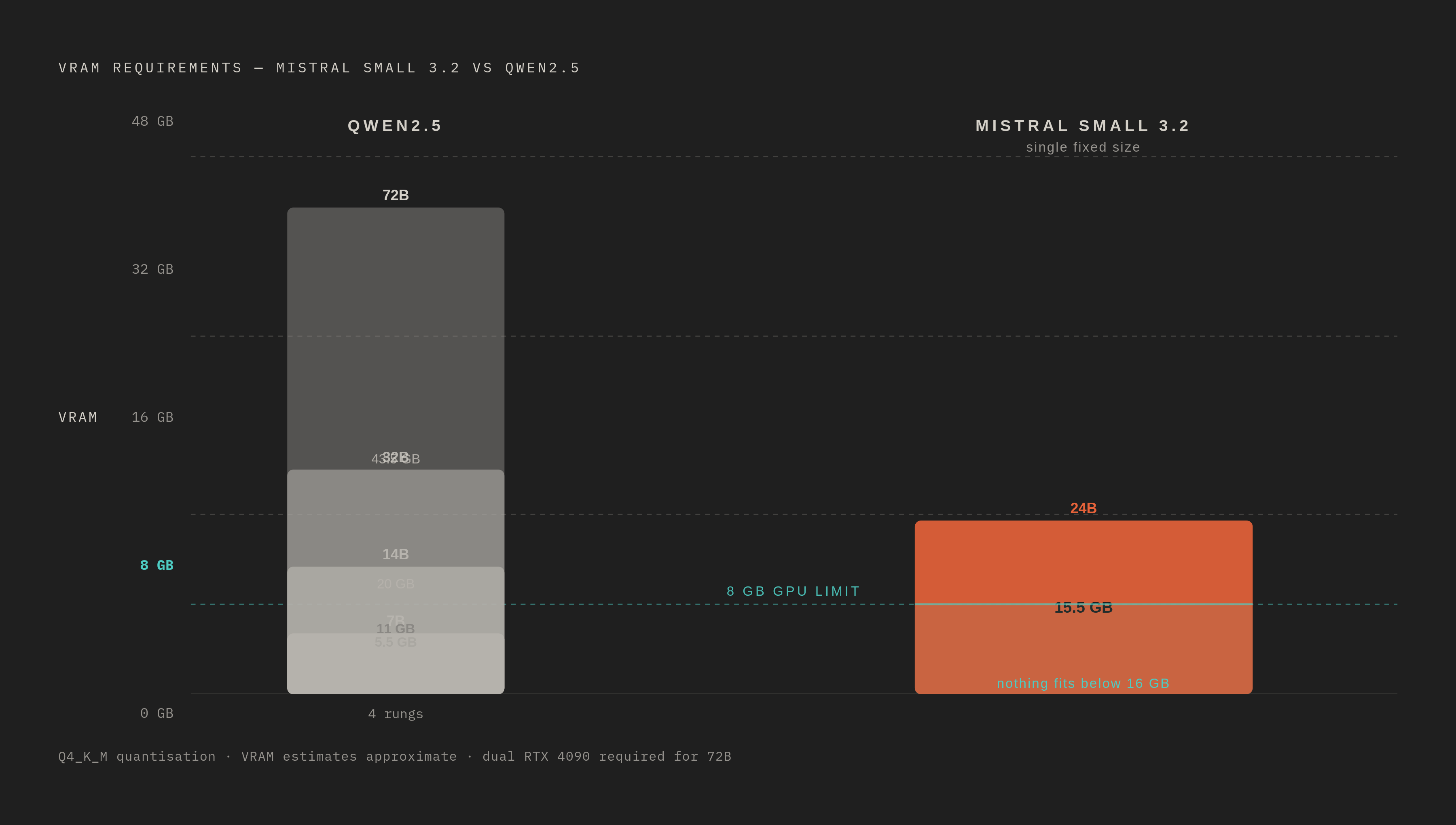
Mistral Small 3.2 comes in exactly one size: 24B parameters, no smaller or larger variant to pick from. At Q4_K_M quantization with an 8K context window, expect around 15.5 GB of VRAM, which fits a single 16 GB consumer card like an RTX 4060 Ti or RTX 4070 Ti Super. Step up to a 24 GB card, an RTX 4090, and INT4 or INT5 quantization fits with room to spare, though budget 22 to 23 GB if the workload pushes toward the full 128K context. On Apple hardware, a 32 GB MacBook with an M3 Max chip runs it through MLX or llama.cpp at something like 20 to 35 tokens per second. Full BF16 precision needs roughly 50 GB of GPU memory (two A100 40 GB cards, two L40S 48 GB cards, or a single H100 80 GB), and on an optimized inference stack, throughput runs around 150 tokens per second.
If 15.5 GB of VRAM doesn't fit the hardware on hand, there's no smaller Mistral Small waiting in reserve. One size, no fallback, no dial to turn.
Qwen2.5 does the opposite, and this is really where it pulls ahead for most deployments. The size ladder is the whole point. The 7B model at Q4_K_M is a 4.7 GB download needing about 5.5 GB of VRAM, runs on an 8 GB GPU, and pushes 60 to 75 tokens per second on something like an RTX 4060 or 4070. Step up to 14B and VRAM needs are around 10 to 12 GB at a default 4K context, comfortable on a 16 GB card. At the top end, 72B at Q4_K_M needs 43.5 GB of VRAM, meaning dual RTX 4090s or comparable multi-GPU infrastructure: not a single-consumer-card situation by any stretch. Drop below 6 to 7 GB of VRAM and Qwen2.5-7B stops being practical on GPU, falling back to slow CPU inference or a hosted API instead. On Apple Silicon, a 32 GB M2 Max can run models that would demand 32 GB of dedicated VRAM on Nvidia hardware, thanks to unified memory, though Nvidia still generates tokens faster at matched memory budgets.
So what does this mean for someone actually provisioning hardware today? A team with an 8 GB GPU has exactly one option here, and it's Qwen2.5-7B, full stop, because Mistral Small has nothing that fits that footprint. A team with 16 to 24 GB of VRAM gets a genuine choice: Mistral Small 3.2 runs at full strength, and Qwen2.5-14B fits with room left over. A team chasing the highest output quality, willing to run Qwen2.5-72B, needs real multi-GPU infrastructure to get there, and there's no version of that build that stays cheap.
Benchmark performance
Read the benchmarks with one caution up front: the most common comparison pits Mistral Small's 24B against Qwen2.5's 7B, a parameter-count mismatch several times over. Any head-to-head built on that pairing is comparing a bigger model against a much smaller one, so raw numbers need context before anyone draws conclusions from them.
Mistral Small 3 24B Instruct scores 87.6% on Arena Hard, 83.5% on MT-Bench, 82.9% on IFEval, 70.6% on MATH, and 84.8% on HumanEval.
Qwen2.5-7B Instruct scores 91.6% on GSM8K, 87.5% on MT-Bench, 79.2% on MBPP, 75.5% on MATH, and 56.3 on MMLU-Pro.
Both land at exactly 84.8% on that HumanEval line, despite Qwen2.5-7B running at roughly a third of Mistral Small's parameter count. That says something about training efficiency, not raw scale. Qwen2.5-7B also beats the much larger Mistral Small on MATH (75.5% versus 70.6%) and GSM8K (91.6%), which suggests Alibaba's training recipe leans hard into mathematical reasoning even at smaller sizes. None of this makes Qwen2.5-7B categorically better than Mistral Small at everything. It means parameter count alone doesn't predict outcome, so check which size class actually fits your hardware before trusting a chart built on mismatched model sizes.
Licensing and data sovereignty: how model origin affects enterprise deployment
Both Mistral Small 3.2 and Qwen2.5, up through the 14B variant, ship under Apache 2.0: free to use commercially, modify, and redistribute, no strings attached. The one exception is Qwen2.5-72B, which runs under Alibaba's own Qwen License instead, a distinction that matters for any team eyeing that specific variant. Apache 2.0 itself imposes no cap on monthly active users, removing a friction point that some other open-weight licenses impose once a fine-tuned deployment scales past a certain size.
Origin is where the real difference sits, and procurement teams treat it as a bigger deal than the technical facts justify. Mistral AI is headquartered in Paris and has positioned itself, explicitly, as Europe's answer to US and Chinese dominance in frontier models. That positioning comes with GDPR awareness baked into how the company talks about deployment, and an eye toward EU AI Act compliance, which matters to regulated sectors like financial services, healthcare, and legal work operating inside the EU. Qwen comes out of Alibaba, a China-based company, and that provenance creates real procurement friction across plenty of European enterprise contexts, plus data-sovereignty questions for US organizations in regulated industries.
No blanket EU law actually mandates data residency. GDPR and the EU AI Act don't impose a universal data-localization requirement, specific sectors or national rules might, but that's not the general case. And there's a bigger fact that cuts through most of the anxiety. When a model runs fully on-device, with no API calls back to anyone's servers, data doesn't leave the hardware it's running on, regardless of which lab trained the weights. Once either model is actually running locally instead of through a hosted endpoint, that fact shrinks the practical sovereignty risk considerably for both.
So for most teams, sovereignty concerns here are a procurement and risk-management question dressed up as a technical one, and the technical answer (nothing leaves the box) mostly settles it. Exceptions exist. Government contractors, EU financial institutions under specific national scrutiny, these are cases where provenance itself is the issue, not the mechanics of deployment, and Mistral's origin counts as a real differentiator there regardless of what the benchmarks say.
Ecosystem, tooling, and fine-tuning support around each model
Both families run cleanly across Ollama, llama.cpp, vLLM, and MLX, and GGUF conversion holds up for both. Tooling alone doesn't settle this decision. The gap opens up a layer deeper, in community size and how fine-tuning actually gets done, and it's not a small gap.
Qwen2.5 sits among the most downloaded model collections on Hugging Face, and community fine-tunes tend to appear within days of a release, not weeks. Support in vLLM and SGLang is well-established, and the sheer size of the community means more tutorials, more Reddit threads working through edge cases, and more pre-built fine-tunes to start from instead of building one from scratch. The 7B and 14B sizes carry lower hardware demands than a 24B model, which matters directly for any team building a domain-specific multilingual model without renting a cluster.
Mistral's ecosystem takes a different shape. Documentation is clean, and the La Plateforme fine-tuning API is polished, with tight integration into the MLOps tooling built around it, which matters if a team is already standardized on that infrastructure. Mistral Small 3 and 3.1 shipped with both base and instruct checkpoints, giving fine-tuners a real starting point below the instruction layer. Small 3.2 ships instruct-only, its underlying base model unchanged from 3.1. Still workable for specialized fine-tuning in legal, medical, or technical domains, just with one fewer checkpoint on hand to start from. For serving Mistral Small in production, the officially recommended stack is vLLM, using paged KV cache and continuous batching, built specifically to keep throughput high under real traffic instead of just under benchmark conditions.
Qwen's ecosystem is bigger and faster-moving, which affects how quickly someone finds help when something breaks at 2 a.m. and you're searching for someone who's already hit the same error.
Sources
- Mistral Small 3.1 in 2026: Benchmarks, Lineup, Comparison
- Mistral just updated its open source Small model from 3.1 to 3.2: here's why | VentureBeat
- mistralai/Mistral-Small-24B-Instruct-2501 · Hugging Face
- Mistral Small 3.1 | Mistral AI
- mistralai/Mistral-Small-3.1-24B-Instruct-2503 · Hugging Face
- Introducing Mistral Small 4 | Mistral AI
- docs.mistral.ai
- huggingface.co