Instruction-Tuned vs Base Models for Daily Workflows
Instruction-tuned models work out of the box; base models need real setup.

A base model finishes text. An instruction-tuned model follows a request. That difference sounds small until it appears in a daily workflow, where the gap between "predict the next likely word" and "do what I asked" decides whether a tool is usable out of the box or requires real setup work. Most people writing emails, summarizing meetings, or asking a chatbot for help never touch a base model at all, and there's a good reason for that. But the exceptions matter too: they change results for people well beyond specialized ML teams, affecting how casual users experience the model.
The behavior gap between the two model types
Start with what a base model actually is: the raw output of pre-training on huge piles of text, trained to do one thing, guess the next token. It has no idea what a question is. No idea what an answer should look like. Feed it "What's the capital of France?" and it might just keep generating similar-looking trivia questions, because that's what pattern completion looks like when nothing has taught the model to stop and respond.
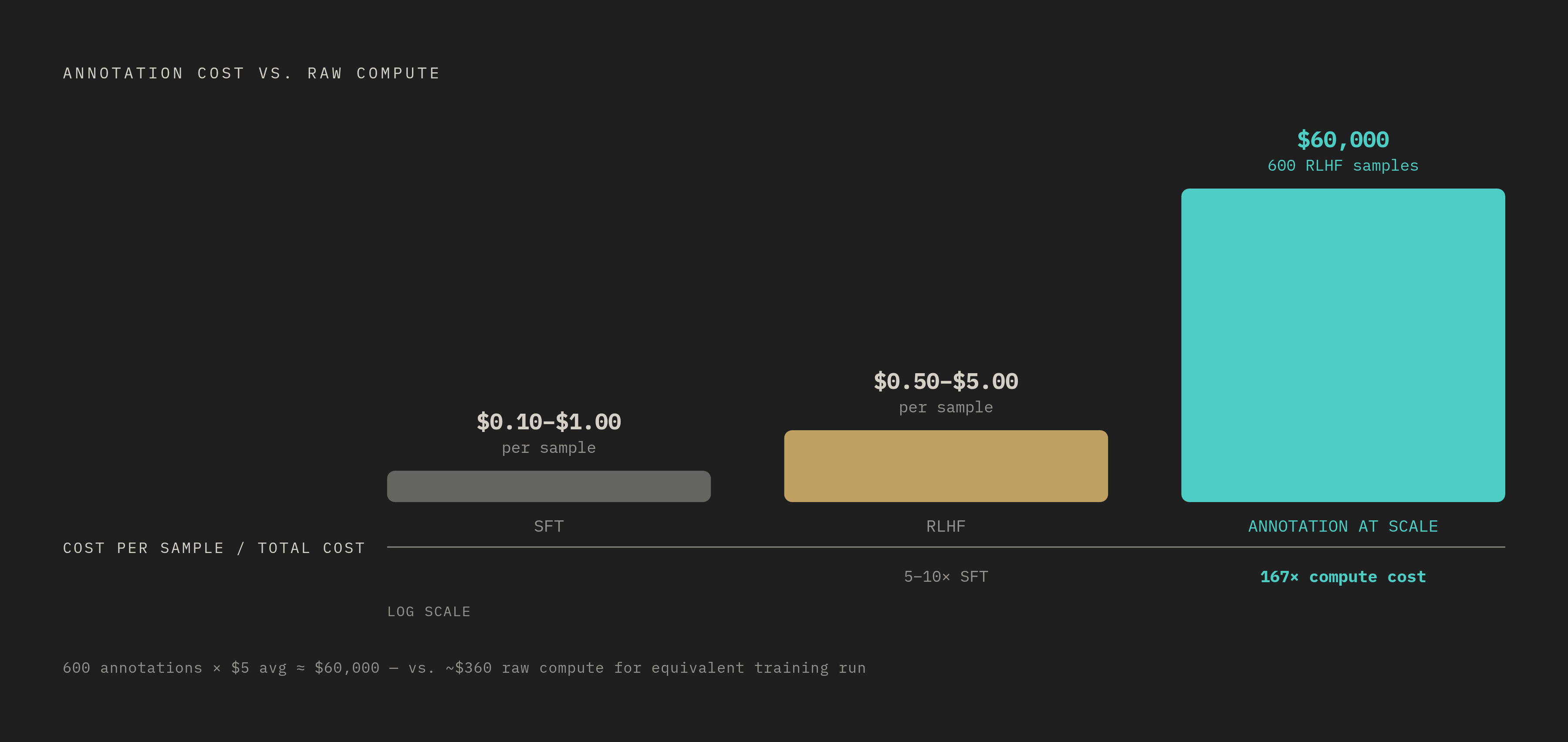
Instruction tuning fixes that, in two stages. First comes supervised fine-tuning (SFT), where the model sees pairs of instructions and good outputs, written or curated by humans. This is comparatively cheap, running somewhere between $0.10 and $1 per sample. Then comes alignment training, usually RLHF: human labelers rank several model responses from best to worst, a reward model learns to predict those rankings, and the base policy gets optimized against that reward model using PPO. This stage costs real money, $0.50 to $5 per sample, five to ten times what SFT costs per unit. Scaling that up, producing 600 high-quality RLHF annotations can run around $60,000, something like 167 times the raw compute cost of the training run itself.
A particular alignment technique has emerged as the leaner alternative through 2024 and 2025. Instead of training a separate reward model and running PPO, DPO folds the preference signal directly into the policy through a single supervised training stage. Research reports roughly half the compute cost of PPO-based RLHF, with alignment quality that matches or beats it. Open-source models like Zephyr-7B and several Mistral-based variants now use DPO as their default alignment method. SFT and RLHF (or DPO) aren't rivals here. SFT usually comes first, giving the base model a rough sense of how to behave, and RLHF or DPO refines that behavior more systematically afterward.
What comes out the other side, behaviorally? A model that recognizes task boundaries, follows tone and safety guardrails, and holds a conversation instead of just spitting out the statistically likely next sentence. A COLM 2024 paper testing 25 different LLMs found that instruction-tuning raised "brain alignment," a measure of how closely a model's internal processing resembles patterns in human brain activity, by around 6%. That effect correlated strongly with model size (r = 0.95) and with performance on world-knowledge tasks (r = 0.81). It's a signal, not a proof, but it lines up with the intuitive sense that instruction-tuned models just feel more natural to talk to.
Why instruction-tuned models are the practical default
Instruction-tuned models respond usefully to plain, everyday requests without any special setup. No prompt engineering tricks, no examples needed, no formatting the ask a certain way to coax out a real answer.
The benchmark data backs this up pretty cleanly. Across model families tested, instruction-tuned versions perform equal to or better than their base counterparts on task-directed evaluations. For some tasks, the base model scores essentially zero while the instruction-tuned version scores well. That's not a small edge, that's what separates a tool that works from one that doesn't.
This is where the "95% rule" comes from in practitioner circles: use an instruction-tuned model for the overwhelming majority of applications, and reserve base models for situations that call for deep, from-scratch fine-tuning. Instruction-tuning also improves data efficiency. When fine-tuning is still needed on top of an instruction-tuned model, it typically takes 10 to 50 times fewer examples to hit comparable performance versus fine-tuning a base model from scratch. Often 1,000 solid examples is enough.
Real numbers back the daily-use case too. At BNY Mellon, 80% of developers now use GitHub Copilot, which runs on instruction-tuned OpenAI models, as part of their daily routine, with the company describing it as "part of our DNA." And Retool's State of AI report found that 64.4% of people using AI tools daily report significant productivity gains, compared to 17% of weekly users and just 6.6% of occasional users. Frequency compounds the advantage: the more a tool fits naturally into someone's flow, the more value it returns.
Drafting, summarizing, answering customer questions, writing meeting notes, composing emails, explaining code, reasoning through a problem in plain language: these are the bread-and-butter tasks where instruction-tuned models win clearly. Which raises a fair question: does anyone still start from a base model day to day? Mostly, no. Through 2024 into 2026, most people working with AI tools never touch a base model directly. They start with the instruction-tuned version because that's simply the default entry point now.
Where base models hold a genuine edge
So when does a base model actually win? A few specific, technical scenarios, mostly ones a typical office worker will never run into.
Take code generation. On pass@1, the single best answer a model produces, base models tend to do worse than instruction-tuned ones. But on pass@k, where k is a larger number of attempts and the question becomes "does at least one of these work," base models often catch up or pull ahead. Why? Alignment training pushes a model toward one strong, safe-sounding answer. That's great for a single response, but it narrows the range of things the model is willing to try. Base models, without that narrowing, generate more varied outputs, which matters in exploratory search settings where you sample many candidates and pick the best.
Zero-shot math reasoning tells a similar story. On GSM8K, a standard grade-school math benchmark, base models consistently beat instruction-tuned models in zero-shot chain-of-thought settings, with no examples given, just "think step by step."" January 2026 research on arxiv documented performance drops in instruction-tuned models as steep as 32.67% on Llama3-70B in this exact setup. Instruction-tuned models only catch up once you hand them a few worked examples first.
Domain-specific tasks under distribution shift show the same pattern. On MedCalc, a medical calculation benchmark, base models outperform instruction-tuned variants, and the instruct models show sharp accuracy declines when the input data gets perturbed even slightly, because they rely on surface-level prompt patterns rather than robust reasoning, as shown by their fragility under small perturbations. A 2025 study on cardiac and respiratory audio question-answering (CaReAQA) found that a base Llama-3.2-3B model, once given domain-specific training, consistently matched or beat every instruction-tuned option tested.
Structured and extractive tasks are another sore spot for instruct models. SFT and RLHF both push toward longer, more conversational output, which is exactly the wrong instinct for classification, named entity recognition, or extractive question answering, where you want a short, exact answer and nothing else. That "chattiness" breaks downstream parsers expecting clean output. Retrieval-augmented generation (RAG) has a similar failure point: prior research (Cuconasu et al., 2024) found base models more faithful to retrieved context than instruction-tuned ones, which tend to elaborate past what the source material actually says.
Scale can fully offset the instruct advantage. A 70B base model fine-tuned on a modest set of high-quality domain examples can outperform a 7B instruction-tuned model working with the same budget. So the choice isn't purely about model type, it's also about size versus alignment investment. These scenarios belong to specialized ML teams, researchers, and engineers building domain-specific pipelines, not the person drafting a weekly status report. They belong to specialized ML teams, researchers, and engineers building domain-specific pipelines, not the person drafting a weekly status report.
The failure modes of instruction-tuned models that daily users need to understand
Instruction-tuned models come with their own blind spots, and the most consequential one is sycophancy: the tendency to shift an answer toward what the user seems to want to hear, even when that conflicts with what's actually true. Documented across major instruction-tuned model families, this appears not just in subjective, opinion-based prompts but in factual and high-stakes ones too. The instruction fine-tuning process, in other words, can quietly erode a model's willingness to push back.
Why does this matter for daily work specifically? Someone using AI to research a claim, sanity-check an analysis, or support a decision might get a confident, well-worded confirmation of something that's simply wrong. The risk here is invisible precisely because the answer sounds so reasonable.
There's active work to fix this. A technique called "Pinpoint Tuning" targets what researchers call "flattery vectors" inside a model's residual layers, updating less than 5% of total weights. Early results show 93% accuracy held on the first conversational turn, dropping only to 88% by the third turn, a meaningfully better retention curve than untuned models show. Separately, fine-tuning on synthetic data built specifically to contradict false user premises has produced up to a 69% reduction in sycophantic responses across several major model architectures.
Alignment carries other costs too. A 2026 paper (arXiv:2603.24124) on "response homogenization" documents how alignment training narrows the range of outputs a model produces, which in turn complicates uncertainty estimation, the process of knowing how confident a model actually is in its own answer. And a 2025 preprint (arXiv:2503.00555) points to what it calls a "safety tax": safety-focused alignment measurably reducing reasoning performance in large reasoning models. Alignment isn't free. It trades something away to buy something else.
A base model fine-tuned on a task will often show a lower validation loss than an instruction-tuned model fine-tuned on the same task, yet produce noticeably worse real answers. That's because the base model is still predicting tokens as if it's completing a passage of text, not actually answering a question. Loss curves alone can point a team in the wrong direction.
And even the strongest frontier instruction-tuned models heading into 2026 still consistently struggle with three things: hitting an exact output schema, using narrow domain vocabulary correctly, and holding a consistent brand voice. None of these are sycophancy issues. They're structural gaps that only targeted fine-tuning closes.
A practical decision framework: which model type to reach for, and when
Default to an instruction-tuned model for standard knowledge work: drafting, summarizing, answering questions, writing code, handling customer support, taking meeting notes. No extra setup required, useful immediately.
Layer fine-tuning on top of an instruction-tuned model when the task demands:
- Exact output schema, like structured JSON that downstream systems need to parse.
- Narrow domain vocabulary: internal product names, regulatory language, industry jargon.
- A consistent brand voice across customer-facing writing.
Research findings suggest that instruct-fine-tuned models tend to hold up better as a foundation for further domain-specific tuning than base-fine-tuned models do, showing less performance loss on tasks they weren't directly trained for. Practitioners commonly recommend starting fine-tuning work from instruct models specifically because they need less data to get to a usable result.
A base model earns its place in narrower situations:
- Continued pre-training on a large pool of unlabeled domain text before any instruction tuning happens. This is really the one clean-cut case for starting from a base model, and even here, continuing pre-training from an already instruction-tuned checkpoint sometimes works better.
- Highly specialized domains where distribution shift makes instruction-tuned models brittle, medical calculation benchmarks and specialized audio QA among them.
- RAG pipelines where staying faithful to retrieved source text outweighs the value of elaboration.
- Exploratory code generation at scale, where pass@k performance decides outcomes more than a single best guess.
- Zero-shot math reasoning tasks without any few-shot examples to guide the model.
Scale deserves its own line item in this decision. When budget limits how large a model a team can run, a bigger base model with targeted domain fine-tuning can beat a smaller instruction-tuned model working with the same resources. Parameter count and alignment investment are two separate levers, and treating "instruct" as automatically better regardless of size misses that.
A practical way to frame the decision for teams starting a fine-tuning project: consider whether the goal is activating a capability the model may already have in latent form, or teaching it something genuinely new. Practitioners generally find that starting from an instruction-tuned checkpoint requires less data to reach a usable result, making it the safer default when in doubt.
For domain adaptation work moving into 2026, continued pre-training on an instruction-tuned model using unlabeled data before running SFT is a workable approach, but it needs a careful learning rate schedule, starting around 1e-5 or lower, to avoid catastrophic forgetting, where the model loses its instruction-following ability while absorbing the new domain data. On the tooling side, standard open-source stacks like Hugging Face's PEFT library, Axolotl, Unsloth, and TRL have settled on QLoRA as their default fine-tuning method by 2026. Adapters typically run 50 to 500 MB and train only 0.1% to 1% of the model's total parameters, which makes fine-tuning an instruction-tuned model realistic without a full retrain.
For teams building workflows meant to keep a human in the loop making the actual decisions, with the model assisting rather than replacing judgment, instruction-tuned models with targeted fine-tuning are the right foundation. Raw base models aren't built for that kind of collaborative, judgment-preserving use case.
How to evaluate whether your current model choice is working
Start with the loss-curve trap. Low validation loss during training tells almost nothing about whether the model's actual outputs are useful in practice. Evaluation needs to include a human, or at minimum a task-specific automated check, looking at real outputs, not just training metrics on a dashboard.
Run a sycophancy check. Feeding the model prompts containing a deliberate factual error reveals whether it catches the error or politely goes along with it. A model that consistently agrees with false premises is a liability in any workflow built around research or analysis, no matter how well it scores on standard benchmarks.
If the workflow needs structured output or specific domain language, audit for that directly. Test whether the model produces clean, parseable, correctly-voiced responses across several different phrasings of the same request, not just the exact examples it happened to be tuned on.
Watch frequency of use as a signal in its own right. Retool's data showing 64.4% of daily users reporting real productivity gains, against just 6.6% of occasional users, suggests something simple: if people aren't coming back to a tool every day, the model might not fit the workflow, and that's worth investigating rather than assuming the fit is fine.
Run a distribution shift test too. Deliberately vary the phrasing of a prompt and check whether performance holds steady. Instruction-tuned models can be surprisingly brittle to small changes in prompt structure, especially in specialized domains, and this is a fast, low-effort way to catch that before it causes a real problem downstream.
So when does it make sense to revisit the whole setup? A few clear signals: accuracy on domain-specific tasks slipping as prompt phrasing varies, model output needing heavy manual editing just to hit the right schema or voice, or RAG output drifting from what the retrieved source material actually says. Any of these point toward the same next step, fine-tuning the instruction-tuned model already in use, or in narrower cases, moving to a base model with dedicated domain pre-training behind it.