Llama 3 vs Mistral for Personal Assistant Tasks
Llama 3 excels at reasoning and long context, while Mistral trades depth for speed and efficiency.
Llama 3 and Mistral both work as personal assistant models, but they're built on opposite bets. Meta's Llama 3 chases reasoning depth and long-context accuracy, even if it costs speed. Mistral chases throughput and low compute cost, even if it means giving up some reasoning headroom. That trade-off appears in specific benchmark scores, specific hardware requirements, and specific licensing terms that decide which model actually fits a given personal assistant task.
Where the architectural difference shows up in benchmark numbers
Start with the number that catches most people off guard. The January 2025 ranking shows Mistral Small 3 scoring over 81% on MMLU while running at roughly 150 tokens per second, a pace that puts it in the same conversation as models three times its size. That's a genuinely impressive efficiency number. But what does it hide?
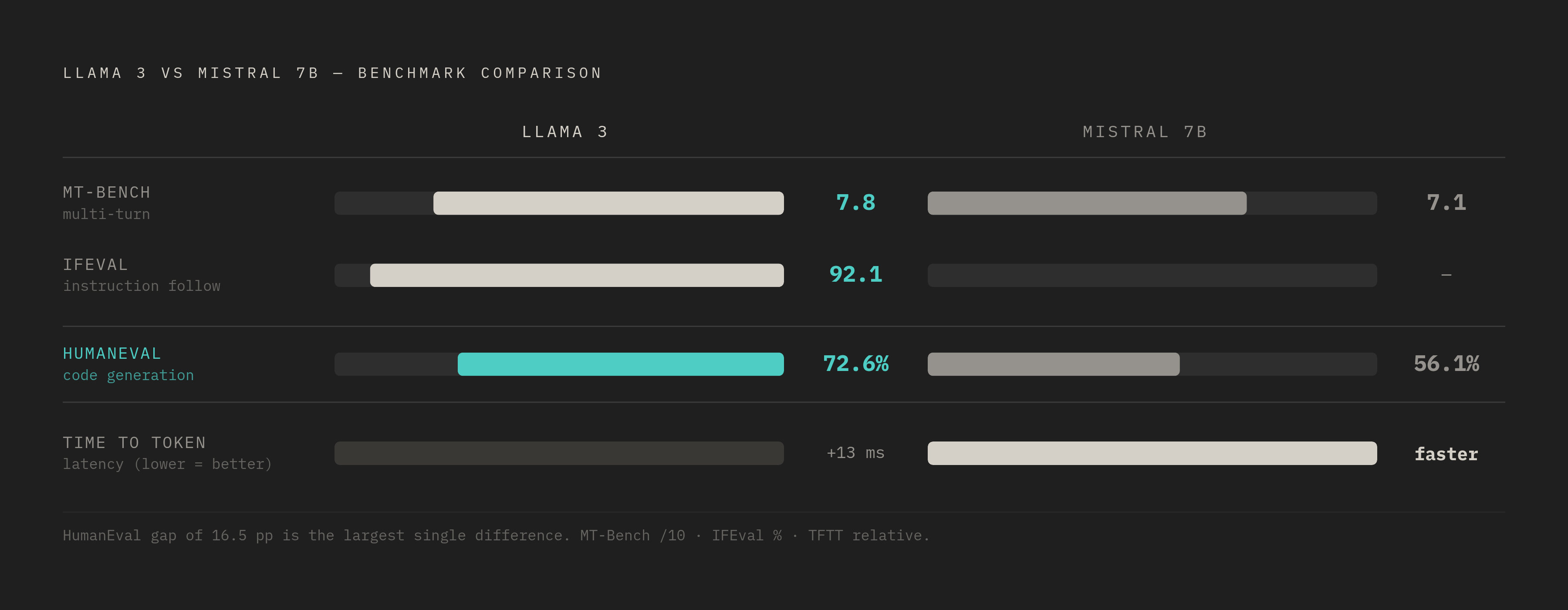
Multi-turn conversation is where the cracks show. On multi-turn conversation quality scoring, Llama 3.1 8B scores 7.8 against Mistral 7B's 7.1. A 0.7-point gap sounds small on paper, but in daily use it means Llama handles follow-up questions, callbacks to something said three messages ago, and pronoun resolution ("what about that one instead") more reliably. Mistral doesn't fall apart on these, it just slips more often on the details that make a conversation feel coherent rather than stitched together.
Instruction following tells a similar story. Llama 3.3 posts a 92.1 on IFEval, a benchmark built around prompts with multiple parts and conditional logic, things like "summarize this, but only include action items, and flag anything urgent in bold." That's exactly the kind of instruction a personal assistant gets asked to follow, and a high IFEval score means fewer dropped sub-clauses.
Coding is where the gap stops being subtle. Llama 3.1 8B hits 72.6% on HumanEval. Mistral 7B is 56.1%. That's not a rounding difference, that's the gap between a script that runs on the first try and one that needs a debugging pass.
Speed, though, tips the other way. Mistral holds a 13 millisecond time-to-first-token edge in head-to-head testing, even though raw throughput ends up nearly identical (100 versus 101 tokens per second on comparable hardware). So the real story isn't "Mistral is faster," it's that Mistral starts responding sooner, which lets a live conversation feel more responsive because the reply begins before Llama's does.
None of this means MMLU or any single benchmark should stand in as a proxy for "better assistant." MMLU measures broad knowledge recall. HumanEval measures code generation. MT-Bench measures conversational quality across multiple turns. A model can lead on one and trail on another, and the only benchmark that matters is the one that maps to the task actually in front of the assistant.
Tasks where Llama 3's reasoning depth and long context are the deciding factors
Long documents are Llama's clearest advantage. Llama 3.1 ships with a 128K token context window trained in from the start, not bolted on afterward as a patch. A context window trained in tends to hold coherence across the full span rather than degrading toward the end. Mistral 7B's native window is 8K (32K from version 0.2 onward), which covers most everyday tasks fine but starts to strain against a 40-page contract or a sprawling email thread that needs to stay in memory all at once.
Complex, multi-step instructions lean the same direction. Think of a travel itinerary with conditional branches: "book the earlier flight if it's under $400, otherwise the direct one, and if neither works, text me before booking anything." That 92.1 IFEval score for Llama 3.3 signals a model that tends to catch every clause rather than executing the first two conditions and quietly dropping the third.
Code assistance is where the choice gets close to obvious. A 72.6% versus 56.1% HumanEval gap means the difference, at the assistant level, between a scheduling script or API integration that works and one that needs a follow-up prompt to fix a broken function call. Mistral's specialized coding model, Codestral 25.01, scores 86.6% on HumanEval, ahead of both. If the task is purely code generation and Codestral is on the table, that changes the math entirely.
Extended conversations, the kind that build up over many sessions on an ongoing project, are where that 7.8 versus 7.1 MT-Bench gap is visible day to day. Pronoun resolution and topic callbacks aren't flashy capabilities, but they're the difference between an assistant that feels like it's tracking the project and one that needs to be re-oriented each session.
Formal or structured output, like policy language, detailed reports, or meeting notes with a rigid format, tends to favor Llama's training and tuning patterns. Mistral, by contrast, adapts more easily to informal, casual tone content, which sets up the next section neatly.
Tasks where Mistral's speed and efficiency are the deciding factors
Flip the task to something real-time, like a live chat reply or a quick calendar lookup, and Mistral's design pays off immediately. Mistral Small 3.1 hits a time to first token of 0.29 seconds. In voice and chat interfaces, sub-300-millisecond response time is roughly the threshold where a conversation still feels natural instead of laggy. That 13-millisecond time-to-first-token edge doesn't sound like much in isolation, but multiply it across dozens of short exchanges in a single day and it adds up to a noticeably snappier assistant.
High-volume, repetitive work is Mistral's other home turf: email triage, one-paragraph summaries, draft replies to templated messages. Mistral Small 3.1 runs at 150 to 166 tokens per second under good conditions, and that throughput matters most when the assistant is chewing through a batch of short tasks back to back rather than one long one. Mistral Small 3 also runs more than three times faster than Llama 3.3 70B on equivalent hardware, which matters directly if 70B-class reasoning is what a task would otherwise demand.
Casual tone and brand-voice work, quick acknowledgments, social copy, informal replies, tends to come more naturally out of Mistral's instruction tuning. It's a smaller advantage than the speed numbers, but it's consistent.
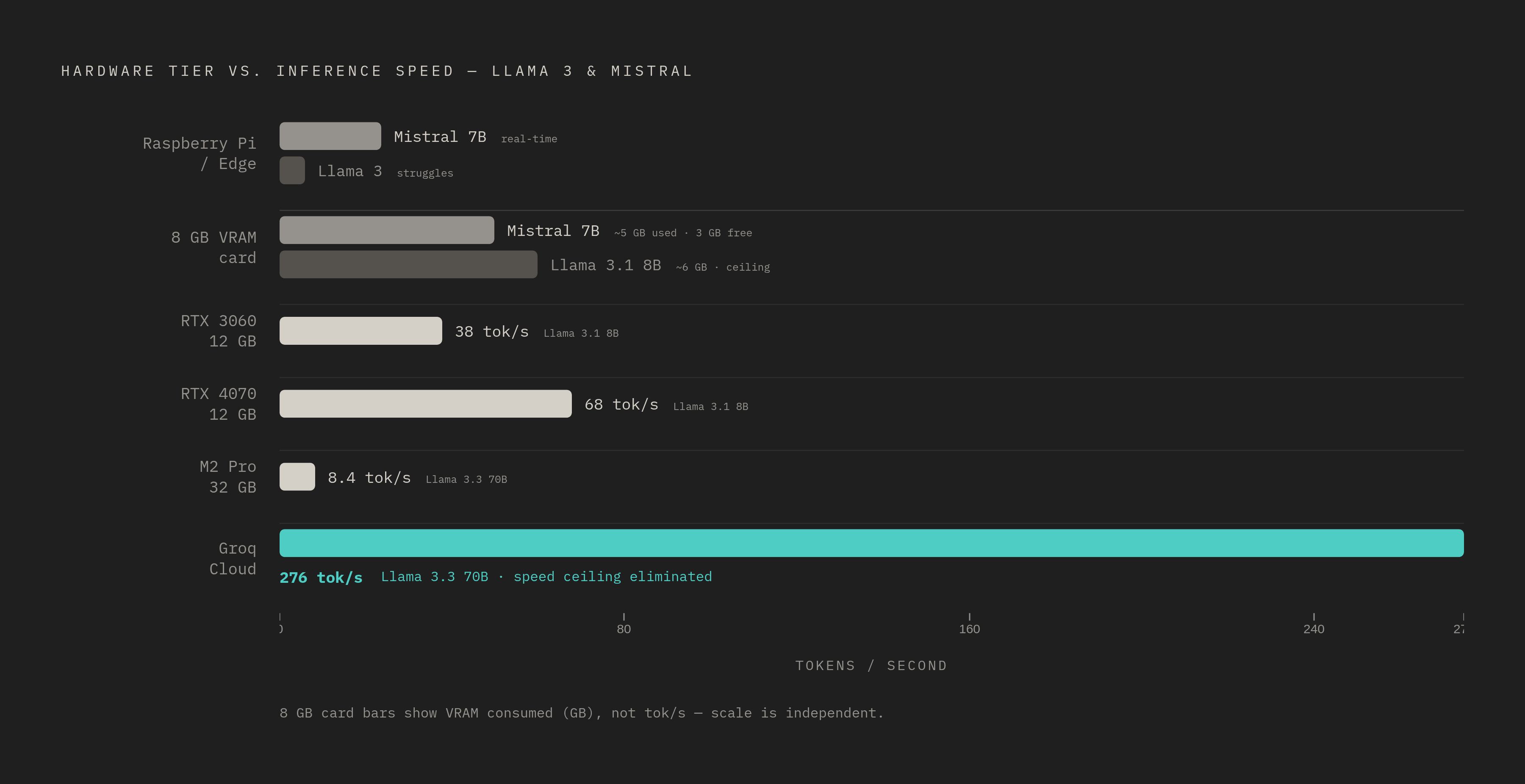
Local deployment on constrained hardware is where the case for Mistral gets concrete. Mistral 7B needs around 5GB of VRAM at 4-bit quantization versus roughly 6GB for Llama 3.1 8B. That gap looks small, but on an 8GB card it's the difference between comfortable headroom and running right at the ceiling. On an M1 MacBook Air with 16GB of RAM, Mistral 7B runs at about 28 tokens per second, which is genuinely usable for professional assistant work. Push down to a Raspberry Pi or similar edge hardware, and Mistral 7B can still deliver real-time responses where Llama 3 models start to struggle.
Agentic pipelines, where a task chains several tool calls together and latency stacks up at every step, also tilt toward Mistral. Mistral 7B version 0.3 introduced native function calling support, which makes it a workable base for lightweight agent setups without reaching for a larger, slower model.
How hardware and deployment context shifts the practical choice
None of the reasoning advantages Llama offers matter if the hardware can't run the model at usable speed. None of the reasoning advantages Llama offers matter if the hardware can't run the model at usable speed, and that limitation is the blunt reality behind this section.
Llama 3.3 70B at 4-bit quantization needs roughly 40GB of disk space and 40GB of RAM or VRAM. Consumer NVIDIA GPUs can't handle that without offloading layers to system memory, which tanks speed. An M2 Pro with 32GB of unified memory can run it, but only at around 8.4 tokens per second, noticeably slower than the smaller models discussed above.
Mid-range GPUs land in a more workable spot for the 8B-class models. An RTX 3060 with 12GB runs Llama 3.1 8B at about 38 tokens per second. Step up to an RTX 4070 with 12GB and that climbs to roughly 68 tokens per second. Mistral Small 3.1 needs quantization to fit comfortably on a single RTX 4090 (24GB VRAM) or a Mac with 32GB of RAM.
So the practical rule is straightforward: if the hardware in front of a user can't run Llama 3.3 70B at a usable pace, its reasoning edge is theoretical. Mistral running at full speed on modest hardware will often beat a heavily quantized or offloaded Llama in real, felt performance, even if Llama would win on a clean benchmark table.
Cloud APIs remove the hardware ceiling entirely and turn the decision into pure capability versus cost. Mistral Small 3.1 runs at $0.10 per million input tokens and $0.30 per million output tokens. Mistral Large 3, with its 256K context window, runs $0.50 in and $1.50 out per million tokens. The older Mistral Large tier sits higher, at $2.00 in and $6.00 out. Llama 3.3 70B is available through cloud inference providers at competitive per-token pricing. Mistral's smaller models generally carry lower per-token costs than comparable Llama tiers across cloud providers.
Groq's hardware also changes the speed calculus for Llama specifically: Llama 3.3 70B hits 276 tokens per second there, recovering the speed disadvantage without anyone needing to buy a GPU. So for an assistant running continuously on a personal machine, Mistral's efficiency compounds all day long. For an assistant that fires off async API calls for the harder tasks, Llama 3.3 70B via Groq becomes a genuinely competitive option at a comparable price point.
Licensing differences for building a personal assistant
Mistral ships under Apache 2.0, a license that allows commercial use, derivative works, and redistribution without meaningful restriction for most users. Mistral 3, released in December 2025, and the full Ministral 3 lineup all carry this license. Certain Mistral models use a modified MIT license that adds extra terms once a company's monthly revenue crosses a substantial threshold.
Llama 3's license carries more baggage. Any service that had more than 700 million monthly active users as of Llama 3's April 18, 2024 release date needs a separate commercial license directly from Meta. There's also a non-competition clause: outputs from Llama 3 can't be used to train a competing large language model. There's also an attribution requirement, and products built on it must display "Built with Llama" somewhere visible, a website, a UI, a blog post, an about page, product documentation.
Critics have argued that the Llama license fails the Open Source Definition on multiple points, largely around the restrictions on certain users and fields of use. Others in the open-source community have gone further, arguing that Llama 3.1's restrictions place it outside the bounds of truly free software.
None of that friction matters much for someone building a personal assistant purely for their own use. Where it matters is commercial distribution: a developer shipping a PA product, or fine-tuning a model for release, should default to Mistral's Apache 2.0 terms unless there's a legal review of what Llama's license actually requires for their specific use case. Mistral's decision to standardize on Apache 2.0 looks less like a compliance afterthought and more like a deliberate positioning call.
Matching the model to the task: a practical decision framework
Three questions decide this.
Task type. Long documents, multi-step conditional instructions, code work, and conversations that span many sessions point toward Llama 3.1 or 3.3, whether that's the 70B model on capable hardware or through a cloud API. Quick replies, real-time back-and-forth, high-volume short tasks, and casual tone work point toward Mistral Small 3.1 or Mistral 7B, ideally running locally.
Hardware. Limited VRAM, an edge device, or an assistant that needs to run always-on locally, that's Mistral 7B or Ministral 3B territory. A mid-range GPU like an RTX 4070 or better, an M2 Pro or Max, or simply an API budget that isn't a concern, and Llama 3.1 8B or even 3.3 70B become realistic options.
Deployment intent. Personal use with no distribution plans, either model works fine, so the choice comes down to capability and what hardware is on hand. Building a commercial product, redistributing a model, or fine-tuning one for public release, Mistral's Apache 2.0 terms are the lower-friction default.
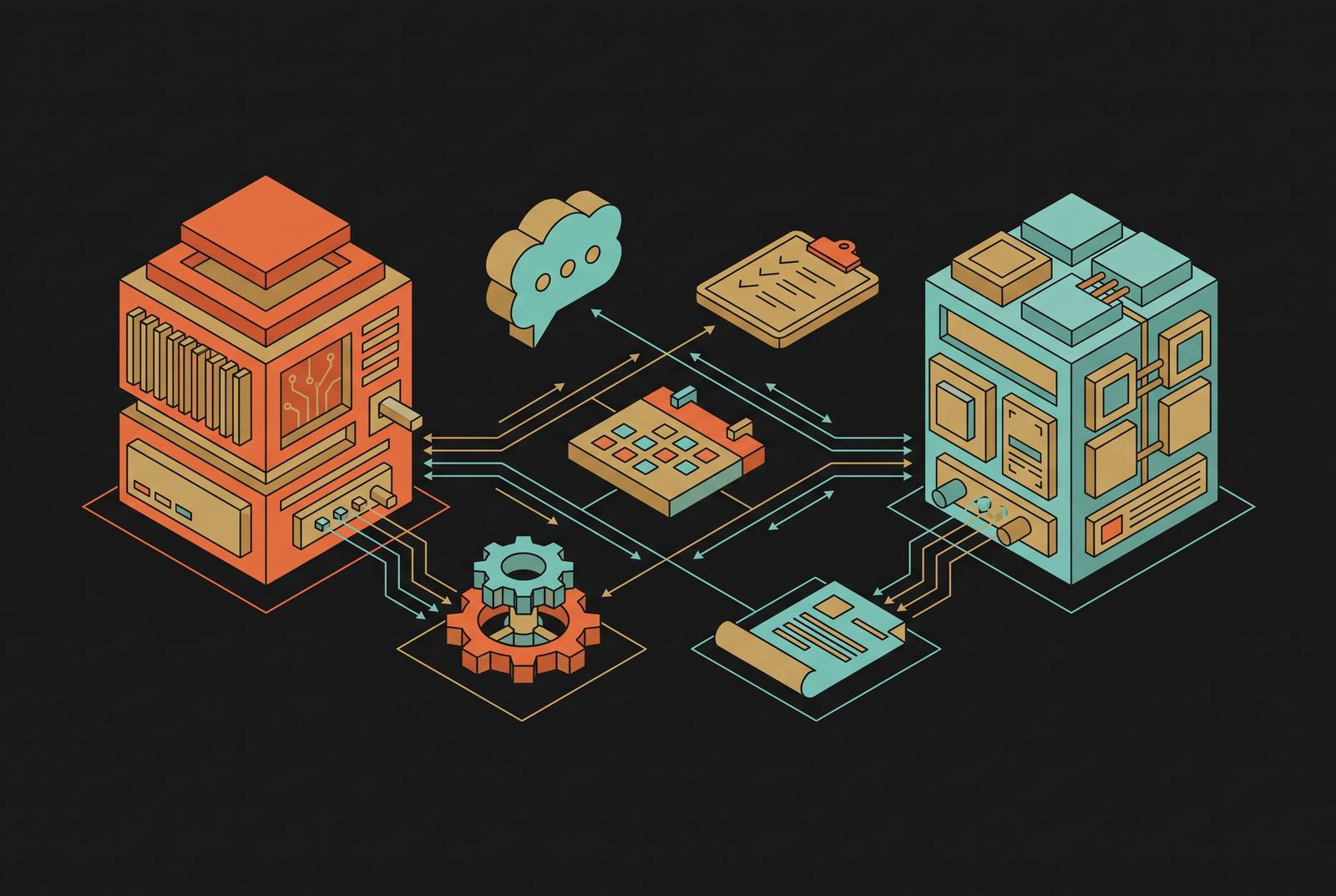
The strongest personal assistant setup might not be a single model at all. Reasoning-heavy work and document tasks route to Llama 3, quick interactions route to Mistral, and an orchestration layer sits above both, sending each query to whichever model fits it. Model choice matters less once something else is doing the work of managing context, routing, and memory across sessions, since a well-built layer above the model can let a user benefit from both without ever manually switching between them.
Neither model wins outright, and the benchmark and hardware numbers above make that case on their own. The right pick depends on the document in front of the assistant, the machine running it, and what happens to the output afterward. A reader who knows their own workload now has a concrete map for where each model actually earns its keep.