Context Length Limits That Matter for Real Workflows
Effective context capacity runs 60-70 percent of advertised maximums in production systems.
The headline number and the number that matters are not the same thing. A model marketed at 1M tokens of context does not reliably reason over 1M tokens. The gap between the two is where most production long-context systems break.
Why the headline context number is not the engineering number
The spec sheet tells you the ceiling. Context refers to the total tokens a model can ingest in one request-response cycle, covering both input and output. That is a hard maximum, not a working capacity. These numbers look generous until you ask what fraction of them a model can actually use.
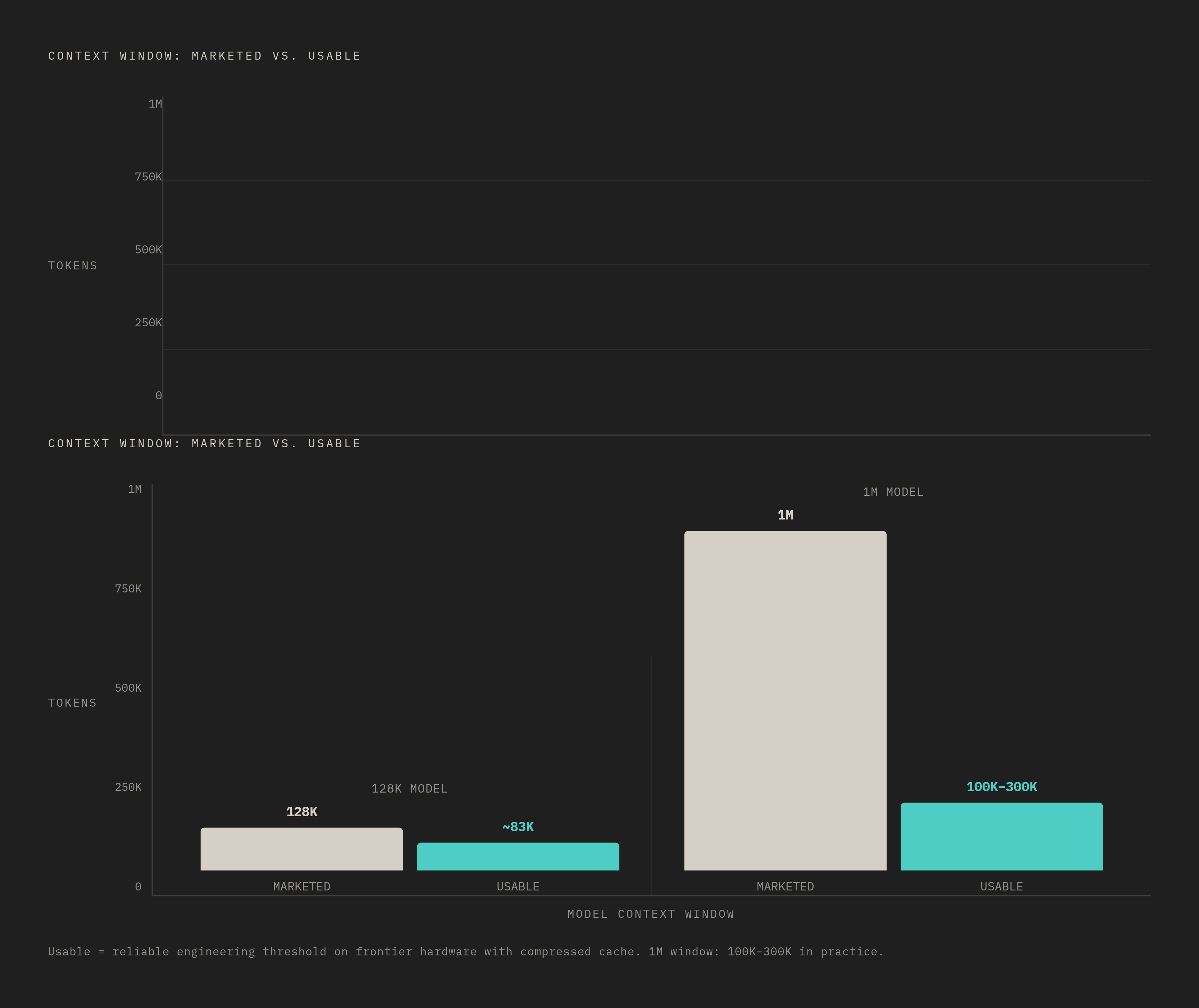
The honest answer, established across multiple evaluations, is that effective usable capacity runs about 60 to 70 percent of the advertised maximum. The drop-off is rarely gradual. Models hold performance until they hit a threshold, then fall sharply. Agent Lingshu's 2026 honest-numbers table makes the gap concrete. A 1M model gets 100K to 300K on frontier hardware with a compressed cache, and quality varies even then.
If you build around the headline, you inherit that falloff. If you build around the reliable threshold, you design for what the model actually does. Every dimension of the problem that follows comes back to this same gap.
The two structural reasons performance degrades before the limit
To see why usable context ends early, look at two independent forces: positional attention bias and hardware memory pressure. Neither one goes away by advertising a larger window. Positional attention bias is a quality limit built into the architecture. The root sits in RoPE long-term decay, which reduces dot-product similarity between distant token pairs. That systematically decreases the attention weight on information sitting in the middle of a context. Softmax normalization then amplifies the problem by concentrating attention on the highest-scoring tokens, which reinforces primacy and recency advantages. A model is structurally predisposed to favor the start and end of what it is given. Mohsin et al. formalize this as encoding attenuation and softmax crowding. As of 2026, no production model has fully eliminated position bias. It is structural, not a bug waiting on a patch.
Hardware memory pressure is the second limit. The KV cache grows with context. A 128K context can demand 8 to 20 GB of cache on a 7B model. Running a 70B parameter model at a full 128K context can take more than 80 GB of VRAM, which is more than a single consumer GPU provides. So most local or self-hosted deployments limit context to 4K to 16K tokens to fit within hardware constraints. For that deployment class, the 1M headline is irrelevant. A 1M-token context is feasible only on large GPUs or with aggressive cache compression. It is not a default operational posture.
The "lost in the middle" effect and its four production failure modes
Position bias shows up in production as four distinct failure modes. Conflating them leads to the wrong fix, so each one needs its own name. The foundational finding comes from Liu et al., TACL 2024, which established the U-shaped attention pattern. Accuracy is highest when relevant information sits at the beginning or end of the input context and degrades materially when it sits in the middle. It replicated across six model families, and additional architectures have since confirmed it. Newer models handle mid-context retrieval somewhat better than older ones, but the effect has not disappeared. Information placement still matters.
The first failure mode is context poisoning. An incorrect belief enters the context and gets reinforced over time. A production version looks like an agent retrieving an outdated API endpoint, failing, and then repeatedly referencing that same bad endpoint because it has learned from its own mistake in-context.
The second is context distraction. As context grows past a threshold, models over-rely on what is in context and under-rely on pretrained knowledge. Llama 3.1 405B shows degraded performance around 32K tokens, and smaller models degrade earlier. The ceiling is model-specific and must be tested, not assumed from the spec sheet.
The third is context confusion. Irrelevant information in context pulls the model toward wrong answers even when the right information is present. LogRocket cites Berkeley's Function-Calling Leaderboard research, which found that Llama 3.1 8B given 46 tools failed a task it succeeded at when researchers reduced the toolset to 19 relevant tools. More options introduced ambiguity that crowded out the task itself.
The fourth is context clash. Contradictory information in context degrades performance significantly, independent of reasoning ability. Early incorrect attempts remain in history and contaminate later reasoning, which makes this a compounding problem in any long-running agentic session.
Where these failure modes hit hardest: software engineering and agentic workflows
Long-context degradation does the most damage where work depends on coherence across distance and time. That describes software engineering and agentic workflows exactly, because attention bias is worst precisely there. In software engineering, even the largest available models cannot simultaneously hold a full codebase, the test suite, the architectural documentation, and the conversation history of a non-trivial project. As projects grow beyond a few thousand lines, an AI agent progressively loses awareness of distant modules, implicit conventions, and cross-cutting dependencies. The practical result is subtle: AI-generated code in large projects may violate architectural patterns or naming conventions established in files outside the current context window. Those inconsistencies can pass local review and then cause integration failures later.
The reasoning context is also transient. When a local agent runs a 40-step refactoring, the resulting Git diff is a wall of changes with no explanation of why each decision was made. The reasoning lived in the context window and vanished when the session ended. Companies facing consequential outputs after August 2026 EU AI Act enforcement will also find that an unauditable context state becomes a regulatory concern, not just a quality one.
Agentic workflows add a failure mode of their own: context drift. Agents work toward a goal across many steps, and with each step, tool outputs accumulate while the original task specification gets pushed back in the attention window. The agent kept re-sending accumulated history on every retry, so it compounded both cost and context contamination.
The compounding cost problem that long-context marketing ignores
The real cost driver in long-context workflows is not the one-off large request. It is the compounding re-send of accumulated history. That can make an architecture that looks viable in testing prohibitively expensive at scale.
Consider an agent session that runs 50 or more tool calls. The history alone can exceed 150K tokens, and those tokens get billed again on every subsequent call. So the spend is both high and low-return at the same time.
Latency runs parallel to cost. A short context with retrieved context returns in one to two seconds. For sub-500ms latency SLAs, long context is not viable regardless of quality.
Two developments in 2025 and 2026 shifted part of this calculus. Anthropic eliminated long-context surcharges on March 13, 2026, which moved the primary constraint from price to quality and latency for enterprise workloads that were previously priced out. When the static portion of a prompt, like a system message, common instructions, or frequently retrieved chunks, is cached, the effective per-call cost drops substantially. That makes long-context architectures viable for use cases where the same corpus gets queried repeatedly, such as legal databases, product documentation, and codebases.
Why larger context windows have not made retrieval obsolete — and when they should replace it
The debate over whether million-token windows make RAG obsolete resolves by workload type, not by window size. For most production workloads, both belong in the architecture. The strongest case for long context replacing retrieval sits in batch document summarization and full codebase review. There, cross-file dependencies require a whole-repo view, and chunking adds no analytical value and may even obscure relationships. Long context is the correct choice for those subtasks.
They solve different problems and increasingly get combined in production. Daily-or-faster changing content demands RAG or a hybrid, because each cache invalidation pays full cold pricing on a very large context all over again.
Architectural patterns that work within the real limits
The engineering response to the advertised-versus-usable gap is not to wait for better models. It is to design systems that treat the reliable range as the constraint, using minimum necessary context, explicit structure, and multi-agent decomposition to stay inside it. Minimum-context construction is the emerging discipline of context engineering. The idea is to restrict the active context to the minimum information required for each subtask rather than loading everything available. Engineered context of roughly 6K tokens outperformed 140K-token naïve loading on both accuracy and latency. The spec sheet is a starting point, not a confirmed number.
Structural information placement works with the attention bias rather than against it. Put critical information first, immediately after the system prompt. That is the highest-attention zone. Put instructions at the end of the prompt, closest to where the model generates its response. That is the second-highest-attention zone. Use explicit markers such as headers, XML tags, and numbered sections to help the model segment long inputs. And avoid padding with marginally relevant content just because context space is available. For RAG pipelines retrieving many chunks, the most relevant chunk must go first or last, never buried in the mid-context attention trough.
Multi-agent decomposition responds directly to the ceiling. Anthropic's 2026 Agentic Coding Trends Report identifies multi-agent workflows as the dominant structural response to task complexity that single agents cannot handle. Each agent operates within its reliable range, and cross-agent coordination handles the dependencies that would otherwise require a single enormous context. The failure mode to design against is the retry loop. Parallel workers that can enter retry loops must have cost and context ceilings enforced externally.
Prefix caching works for repeated-corpus workflows. For legal databases, product documentation, and codebases queried repeatedly against the same static material, caching converts the cost of long context from per-call to amortized. But cache strategy must match update frequency. Invalidating a large cached prefix on daily-changing content erases the economic benefit entirely.
Finally, observability at the context level matters because context drift and context clash are invisible in the output until they have already caused a failure. Agentic systems need tooling that makes context state inspectable, not just outputs. Platforms that give teams a reasoning engine with pattern understanding and context awareness, rather than raw API access, earn their keep here. The intelligence layer that tracks what is in context, flags drift, and manages the window as a first-class resource is the difference between a prototype and a production system.
How to calibrate which architecture a given workflow actually needs
Choosing a context strategy is not a model comparison problem. It is a workflow characterization problem. The right questions concern information update frequency, latency requirements, reasoning depth, and context-state visibility, not who has the largest advertised window.
The questions are straightforward. How often does the source material change? Static content points to long context with caching. Daily changes point to RAG or a hybrid. What is the latency SLA? Sub-500ms rules out long context for retrieval, while seconds-scale makes hybrid approaches viable. Does the task require cross-document reasoning or whole-file coherence? If yes, long context suits that subtask. If no, retrieval is almost always cheaper and more accurate. More than about 15 tool calls means a mandatory context management strategy, not an optional one. If not, then consequential outputs carry regulatory and quality risk, especially after the August 2026 EU AI Act enforcement.
Verify the real usable limit empirically for each model on each hardware configuration, then design the information architecture to stay inside it. Generalist systems that retain context indiscriminately struggle with this. Context engineering requires an opinionated layer above the model, one that understands task structure well enough to know what to include and what to evict. Treat the advertised context window as the ceiling for marketing and the reliable range as the floor for engineering. Design for the floor, instrument for observability, and let the architecture do the work that a larger window cannot reliably do on its own.