Reasoning Model Benchmarks for Local Deployment
Benchmarking reasoning models requires measuring hardware constraints, not just accuracy scores.

Reasoning model benchmarks for local deployment need to answer more than which model scores highest. Local deployment requires a model that can deliver reliable results within the hardware, latency, and compliance limits of the job.
Why local deployment forces a different evaluation question than the leaderboard asks
Distillation helped turn local reasoning from a niche pursuit into a standard engineering workflow. DeepSeek R1 demonstrated that the reasoning patterns of larger models could be distilled into smaller ones, challenging the assumption that strong reasoning required cloud-scale infrastructure. Consumer hardware has also gained memory capacity over the past decade. Together, these changes made hardware a sliding constraint.
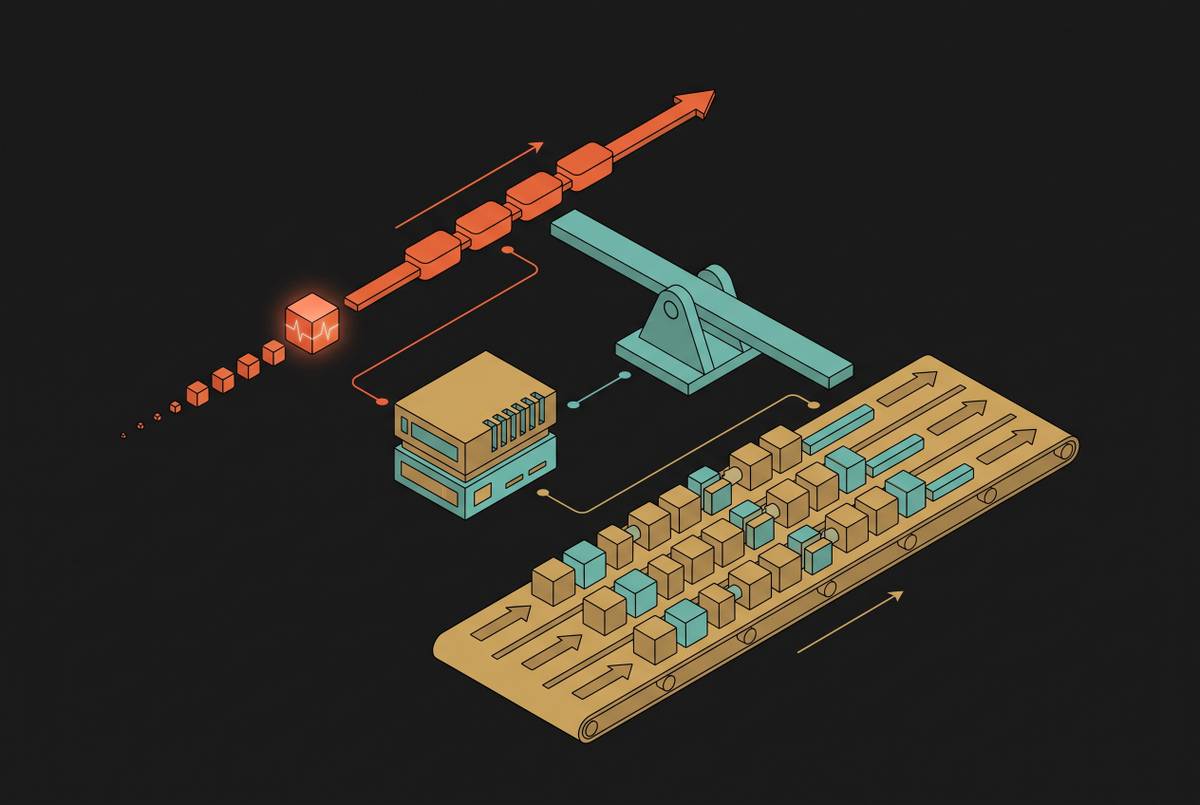
Yet a leaderboard still compresses performance into a single accuracy ranking. Local deployment has to balance at least three things, which are capability, memory footprint, and throughput. A model’s ability to solve a problem matters, but so does whether it can return the answer within the required time on the available machine. The same model can therefore be the right choice on one machine and the wrong choice on another, a distinction no leaderboard communicates.
What the standard reasoning benchmarks actually measure, and where each one breaks down
AIME tests deep, multi-step mathematical reasoning at competition level. Its weakness is the small number of problems published each year, which limits the statistical reliability of a score. MATH-500 has five hundred competition math problems at five difficulty levels, so it is useful for testing multi-step symbolic reasoning. But it is partially saturated, with even small distilled models reaching accuracy high enough to make it less useful for separating candidates.
GPQA Diamond tests what a model knows about PhD-level biology, chemistry, and physics. Non-expert PhD holders score around 34%, giving the test a meaningful reference point, and it still separates frontier open models in the evidence provided. LiveCodeBench addresses a different problem by continually refreshing its coding questions, resisting contamination from memorized test material. HLE, or Humanity's Last Exam, is designed to resist saturation longer than GPQA Diamond and is likely to become a more important differentiator over the next year or two.
These tests are useful, but their limits differ. Static benchmarks lose discrimination as models improve, and nearly half show a pattern of increasing saturation with age. MMLU has already saturated for frontier models, while changes to the symbolic structure of questions expose another weakness in smaller RL-tuned models. Each benchmark answers a capability question.
The deployment variables that benchmarks omit and why they change the ranking
Memory, latency, prompt sensitivity, and format reliability can all change which model is the best practical choice. Throughput is especially important because a strong answer is not enough when it arrives too slowly for the task. A comparison between Gemma and Qwen3.6 therefore needs reasoning scores and measurements on the intended hardware and context length.
Memory introduces another complication through MoE architecture. An MoE model activates only a fraction of its parameters per token, so total parameter count alone is not a useful guide to its operating demands. But active parameters are not a substitute for measuring the model’s actual memory footprint either. Hardware planning needs to distinguish the work done per token from the memory needed to run the chosen configuration. Otherwise, a convenient size label can stand in for the very constraint that determines feasibility.
Configuration can also reverse an apparent advantage. Reasoning models tend to prefer zero-shot over few-shot prompting, with a reported gain of more than ten percentage points for one model. They can also degrade faster than instruction-tuned models at non-zero temperature, with a reported drop of more than twenty-five accuracy points in one configuration. Finally, correct reasoning can still fail if the final answer cannot be extracted reliably. Format reliability is therefore a separate requirement alongside reasoning quality.
How to read VRAM tiers as the first filter before any benchmark score matters
The first branch in model selection is the hardware budget. If the available machine is in the ~8 GB VRAM tier, the relevant candidates are those that can operate within that limit. Microsoft's Phi-4 Reasoning illustrates why capability cannot be inferred from model size alone, outperforming larger distilled models associated with the ~12 GB VRAM tier on several reasoning benchmarks. The hardware named for the smaller tier includes RTX 4060 8GB, RTX 3060 8GB, or any Mac with 16 GB+ unified memory. Those labels establish a starting boundary, with suitability still dependent on the workload.
If the hardware budget extends to high-end or multi-GPU systems, a different field becomes relevant. DeepSeek-V4 Pro has 1.6 trillion total parameters with a much smaller active slice per token and leads the open-weight reasoning and coding pack in the evidence provided. The largest DeepSeek R1 variant requires hundreds of gigabytes at Q4, placing it in multi-GPU territory. These models belong in the comparison only when the infrastructure can support them.
OpenAI's GPT-OSS adds another branch, with a smaller variant aimed at a consumer-class VRAM budget and a larger variant targeting high-end single-GPU or multi-GPU setups. OpenAI's model card places the smaller variant comparably to o3-mini on common benchmarks. That makes local deployment relevant even for a historically closed-weight lab, but it does not make inference free. Infrastructure costs remain part of the decision.
Which benchmarks carry the most signal once hardware has narrowed the field
Within a feasible tier, a benchmark matters most when it still separates candidates and resembles the intended work. For less capable models, AIME and GPQA Diamond can help test how well they handle mathematical and multi-step reasoning. At stronger levels, partially saturated tests such as MATH-500 deserve less weight when candidates are already clustered near the top. GPQA Diamond remains useful for distinguishing frontier open models, while HLE is designed to preserve that discrimination as capability advances. The aim is not to collect more scores, but to find scores that can change the decision.
Task type then sharpens the comparison. For coding at any tier, LiveCodeBench’s rolling refresh makes it the strongest contamination-resistant signal in the notes. For agentic and planning work, tests built for the task can show differences that general reasoning scores miss. PlanBench-V shows the best 2026 agentic reasoning model outperforming the best 2025 model by 27% on spatial planning tasks. Even the lightest 2026 model beats the top 2025 score, but this result applies only to spatial planning map interpretation within agentic work.
This also changes what counts as success. Lighter models can handle many daily tasks, so evaluation can help assign work. The 38-task real-work benchmark found that pass rate predicted agentic reliability better than accuracy. A model with slightly lower accuracy and a perfect pass rate can be more production-ready than one whose stronger answers fail required formats.
When data sovereignty is the constraint that overrides benchmark comparison entirely
For some organizations, the decisive filter is not performance at all. Data residency requirements can make control over infrastructure a condition of using a model. In that setting, DeepSeek the open-weight model can run on controlled infrastructure, while DeepSeek the API transmits prompts to servers in China governed by Chinese law. The API has no enterprise Data Processing Addendum, no Business Associate Agreement, and no EU or US data residency.
Australia, Taiwan, and a number of US federal agencies and state governments have restricted the DeepSeek API on official devices. Those restrictions do not make the open-weight model unavailable for private deployment. When open weights run on infrastructure the organization controls without transmitting prompt data to a third party, the organization remains the data controller and processor. Existing GDPR and HIPAA controls still apply.
GDI Solutions built a blueprint for self-hosting DeepSeek-R1 and quantized open-source reasoning models on private local infrastructure for Singapore legal, financial, and healthcare organisations. GDI Solutions identifies public AI APIs as a source of cross-border compliance liabilities under PDPA Section 26. This makes sovereignty architecture a prerequisite. Once that requirement is met, however, the organization still needs to choose a model.
The strongest objection: benchmark scores may not transfer to production tasks
The strongest objection is that even a careful benchmark comparison may overstate practical value enough to make a hardware investment unjustifiable. Epoch AI reports that, since January 2026, the most capable open-weight models have trailed frontier closed models by an average of roughly four months in its aggregate capability measure. The gap on GPQA Diamond is small, but it exists.
A 2026 analysis found a 40–75% drop in symbolic consistency when benchmark problems were variablized for smaller RL-tuned models. That result suggests that some models seem strong at reasoning because they know the problem structures, while their generalization to changed structures is less reliable. In tests of real tasks, reasoning also has the highest failure rate of all the task categories tested. Buyers expect the most benefit from reasoning, so they need to look most closely at how much they can trust its benchmark scores.
Operational costs strengthen the objection. Running a large MoE model across multiple GPUs takes a lot of infrastructure work, and teams that lack GPU experience will get to production faster with managed deployment. A score advantage does not by itself justify that overhead. Pass-rate measurement, testing at production temperature and context length, and routing tasks across models can reduce the gap. An oracle task-aware router achieves a marginally higher weighted score than any single model in the deployment-aware evaluation, showing room for improvement without proving that a practical router will capture all of it.
A practical evaluation sequence for selecting a local reasoning model
Start by establishing the hardware tier and identifying which model size classes fit at Q4 quantization. Allow for how MoE active parameters work, and use more than total parameter count to estimate memory needs. Then identify whether data sovereignty constrains the choice. If it does, confirm that candidates are available as open weights for self-hosting before comparing their benchmark results. Hardware and compliance together define the eligible set.
Within that set, choose benchmark evidence by task. Weight AIME and GPQA Diamond for math and multi-step reasoning, LiveCodeBench for coding, and domain-specific evaluations for agentic work. For those agentic tasks, put more weight on pass rate than on raw accuracy. Next, compare zero-shot and few-shot prompting at the temperature the model will use in production. Zero-shot is the better default for reasoning models in the evidence provided, but its advantage varies by model and task.
Then measure throughput at the context length the work actually requires. Short-context scores do not establish long-context behavior, so that test belongs before a commitment to a model. For mixed workloads, consider pairing a fast lightweight model for routine work with a heavier reasoning model for complex tasks. Only after these conditions are satisfied should leaderboard rank act as a tiebreaker within the feasible tier. The selection is complete when the model fits the work and its constraints.